
Reading I Isaiah 26:1-6

On that day they will sing this song in the land of Judah:

    “A strong city have we;
        he sets up walls and ramparts to protect us.
    Open up the gates
        to let in a nation that is just,
        one that keeps faith.
    A nation of firm purpose you keep in peace;
        in peace, for its trust in you.”

    Trust in the LORD forever!
        For the LORD is an eternal Rock.
    He humbles those in high places,
        and the lofty city he brings down;
    He tumbles it to the ground,
        levels it with the dust.
    It is trampled underfoot by the needy,
        by the footsteps of the poor.

Responsorial Psalm Psalm 118:1 and 8-9, 19-21, 25-27a

R.    (26a)  Blessed is he who comes in the name of the Lord.
or:
R.    Alleluia.
Give thanks to the LORD, for he is good, 
    for his mercy endures forever.
It is better to take refuge in the LORD
    than to trust in man.
It is better to take refuge in the LORD
    than to trust in princes. 
R.    Blessed is he who comes in the name of the Lord.
or:
R.    Alleluia.
Open to me the gates of justice;
    I will enter them and give thanks to the LORD.
This gate is the LORD’s;
    the just shall enter it.
I will give thanks to you, for you have answered me
    and have been my savior.
R.    Blessed is he who comes in the name of the Lord.
or:
R.    Alleluia.
O LORD, grant salvation!
    O LORD, grant prosperity!
Blessed is he who comes in the name of the LORD;
    we bless you from the house of the LORD.
    The LORD is God, and he has given us light.
R.    Blessed is he who comes in the name of the Lord.
or:
R.    Alleluia.

Alleluia Isaiah 55:6

R. Alleluia, alleluia.
Seek the LORD while he may be found;
call him while he is near.
R. Alleluia, alleluia.

Gospel Matthew 7:21, 24-27

Jesus said to his disciples:
“Not everyone who says to me, ‘Lord, Lord,’
will enter the Kingdom of heaven,
but only the one who does the will of my Father in heaven.

“Everyone who listens to these words of mine and acts on them
will be like a wise man who built his house on rock. 
The rain fell, the floods came,
and the winds blew and buffeted the house. 
But it did not collapse; it had been set solidly on rock. 
And everyone who listens to these words of mine
but does not act on them
will be like a fool who built his house on sand. 
The rain fell, the floods came,
and the winds blew and buffeted the house. 
And it collapsed and was completely ruined.”

– – –

Lectionary for Mass for Use in the Dioceses of the United States, second typical edition, Copyright © 2001, 1998, 1997, 1986, 1970 Confraternity of Christian Doctrine; Psalm refrain © 1968, 1981, 1997, International Committee on English in the Liturgy, Inc. All rights reserved. Neither this work nor any part of it may be reproduced, distributed, performed or displayed in any medium, including electronic or digital, without permission in writing from the copyright owner.

Daily Meditation

 

Saint of the Day


St. John of Damascus

St. John of Damascus

Feast date: Dec 04
Catholics remember and celebrate the life of the great Arab Church Father St. John of Damascus on Dec. 4.Eastern Orthodox Christians and Eastern Catholics, whose tradition has been particularly shaped by his insights, celebrate the saint’s feast on the same day as the Roman Catholic Church.Among Eastern Christians, St. John (676-749) is best known for his defense of Christian sacred art, particularly in the form of icons. While the churches of Rome and Constantinople were still united during St. John’s life, the Byzantine Emperor Leo III broke radically from the ancient tradition of the church, charging that the veneration of Christian icons was a form of idolatry.John had grown up under Muslim rule in Damascus, as the child of strongly Christian parents. His excellent education – particularly in theology – prepared him well to defend the tradition of sacred iconography, against the heresy of the “iconoclasts,” so-called because they would enter churches and destroy the images therein.During the 720s, the upstart theologian began publicly opposing the emperor’s command against sacred images in a series of writings. The heart of his argument was twofold: first, that Christians did not actually worship images,  but rather, through them they worshiped God, and honored the memory of the saints. Second, he asserted that by taking an incarnate physical form, Christ had given warrant to the Church’s depiction of him in images.By 730, the young public official’s persistent defense of Christian artwork had made him a permanent enemy of the emperor, who had a letter forged in John’s name offering to betray the Muslim government of Damascus. The ruling caliph of the city, taken in by the forgery, is said to have cut off John’s hand. The saint’s sole surviving biography states that the Virgin Mary acted to restore it miraculously. John eventually managed to convince the Muslim ruler of his innocence, before making the decision to become a monk and later a priest.Although a number of imperially-convened synods condemned John’s advocacy of Christian iconography, the Roman church always regarded his position as a defense of apostolic tradition. Years after the priest and monk died, the Seventh Ecumenical Council vindicated his orthodoxy, and ensured the permanent place of holy images in both Eastern and Western Christian piety.St. John of Damascus’ other notable achievements include the “Exact Exposition of the Orthodox Faith,” a work in which he systematized the earlier Greek Fathers’ thinking about theological truths in light of philosophy. The work exerted a profound influence on St. Thomas Aquinas and subsequent scholastic theologians. Centuries later, St. John’s sermons on the Virgin Mary’s bodily assumption into heaven were cited in Pope Pius XII’s dogmatic definition on the subject.The saint also contributed as an author and editor, to some of the liturgical hymns and poetry that Eastern Orthodox and Eastern Catholics still use in their celebrations of the liturgy.“Show me the icons that you venerate, that I may be able to understand your faith.” – Saint John of Damascus

Reading 1 Isaiah 25:6-10a

On this mountain the LORD of hosts
will provide for all peoples
A feast of rich food and choice wines,
juicy, rich food and pure, choice wines.
On this mountain he will destroy
the veil that veils all peoples,
The web that is woven over all nations;
he will destroy death forever.
The Lord GOD will wipe away
the tears from all faces;
The reproach of his people he will remove
from the whole earth; for the LORD has spoken.

On that day it will be said:
“Behold our God, to whom we looked to save us!
This is the LORD for whom we looked;
let us rejoice and be glad that he has saved us!”
For the hand of the LORD will rest on this mountain.

Responsorial Psalm Psalm 23:1-3a, 3b-4, 5, 6

R. (6cd) I shall live in the house of the Lord all the days of my life.
The LORD is my shepherd; I shall not want.
In verdant pastures he gives me repose;
Beside restful waters he leads me;
he refreshes my soul.
R. I shall live in the house of the Lord all the days of my life.
He guides me in right paths
for his name’s sake.
Even though I walk in the dark valley
I fear no evil; for you are at my side
With your rod and your staff
that give me courage.
R. I shall live in the house of the Lord all the days of my life.
You spread the table before me
in the sight of my foes;
You anoint my head with oil;
my cup overflows.
R. I shall live in the house of the Lord all the days of my life.
Only goodness and kindness follow me
all the days of my life;
And I shall dwell in the house of the LORD
for years to come.
R. I shall live in the house of the Lord all the days of my life.

Alleluia <a href="https://bible.usccb.orgroute? “>

R. Alleluia, alleluia.
Behold, the Lord comes to save his people;
blessed are those prepared to meet him.
R. Alleluia, alleluia.

Gospel Matthew 15:29-37

At that time:
Jesus walked by the Sea of Galilee,
went up on the mountain, and sat down there.
Great crowds came to him,
having with them the lame, the blind, the deformed, the mute,
and many others.
They placed them at his feet, and he cured them.
The crowds were amazed when they saw the mute speaking,
the deformed made whole,
the lame walking,
and the blind able to see,
and they glorified the God of Israel.

Jesus summoned his disciples and said,
“My heart is moved with pity for the crowd,
for they have been with me now for three days
and have nothing to eat.
I do not want to send them away hungry,
for fear they may collapse on the way.”
The disciples said to him,
“Where could we ever get enough bread in this deserted place
to satisfy such a crowd?”
Jesus said to them, “How many loaves do you have?”
“Seven,” they replied, “and a few fish.”
He ordered the crowd to sit down on the ground.
Then he took the seven loaves and the fish,
gave thanks, broke the loaves,
and gave them to the disciples, who in turn gave them to the crowds.
They all ate and were satisfied.
They picked up the fragments left over–seven baskets full.

– – –

Lectionary for Mass for Use in the Dioceses of the United States, second typical edition, Copyright © 2001, 1998, 1997, 1986, 1970 Confraternity of Christian Doctrine; Psalm refrain © 1968, 1981, 1997, International Committee on English in the Liturgy, Inc. All rights reserved. Neither this work nor any part of it may be reproduced, distributed, performed or displayed in any medium, including electronic or digital, without permission in writing from the copyright owner.

Daily Meditation


Saint of the Day


St. John of Damascus

St. John of Damascus

Feast date: Dec 04
Catholics remember and celebrate the life of the great Arab Church Father St. John of Damascus on Dec. 4.Eastern Orthodox Christians and Eastern Catholics, whose tradition has been particularly shaped by his insights, celebrate the saint’s feast on the same day as the Roman Catholic Church.Among Eastern Christians, St. John (676-749) is best known for his defense of Christian sacred art, particularly in the form of icons. While the churches of Rome and Constantinople were still united during St. John’s life, the Byzantine Emperor Leo III broke radically from the ancient tradition of the church, charging that the veneration of Christian icons was a form of idolatry.John had grown up under Muslim rule in Damascus, as the child of strongly Christian parents. His excellent education – particularly in theology – prepared him well to defend the tradition of sacred iconography, against the heresy of the “iconoclasts,” so-called because they would enter churches and destroy the images therein.During the 720s, the upstart theologian began publicly opposing the emperor’s command against sacred images in a series of writings. The heart of his argument was twofold: first, that Christians did not actually worship images,  but rather, through them they worshiped God, and honored the memory of the saints. Second, he asserted that by taking an incarnate physical form, Christ had given warrant to the Church’s depiction of him in images.By 730, the young public official’s persistent defense of Christian artwork had made him a permanent enemy of the emperor, who had a letter forged in John’s name offering to betray the Muslim government of Damascus. The ruling caliph of the city, taken in by the forgery, is said to have cut off John’s hand. The saint’s sole surviving biography states that the Virgin Mary acted to restore it miraculously. John eventually managed to convince the Muslim ruler of his innocence, before making the decision to become a monk and later a priest.Although a number of imperially-convened synods condemned John’s advocacy of Christian iconography, the Roman church always regarded his position as a defense of apostolic tradition. Years after the priest and monk died, the Seventh Ecumenical Council vindicated his orthodoxy, and ensured the permanent place of holy images in both Eastern and Western Christian piety.St. John of Damascus’ other notable achievements include the “Exact Exposition of the Orthodox Faith,” a work in which he systematized the earlier Greek Fathers’ thinking about theological truths in light of philosophy. The work exerted a profound influence on St. Thomas Aquinas and subsequent scholastic theologians. Centuries later, St. John’s sermons on the Virgin Mary’s bodily assumption into heaven were cited in Pope Pius XII’s dogmatic definition on the subject.The saint also contributed as an author and editor, to some of the liturgical hymns and poetry that Eastern Orthodox and Eastern Catholics still use in their celebrations of the liturgy.“Show me the icons that you venerate, that I may be able to understand your faith.” – Saint John of Damascus

Reading 1 Isaiah 11:1-10

On that day,
A shoot shall sprout from the stump of Jesse,
and from his roots a bud shall blossom.
The Spirit of the LORD shall rest upon him:
a Spirit of wisdom and of understanding,
A Spirit of counsel and of strength,
a Spirit of knowledge and of fear of the LORD,
and his delight shall be the fear of the LORD.
Not by appearance shall he judge,
nor by hearsay shall he decide,
But he shall judge the poor with justice,
and decide aright for the land’s afflicted.
He shall strike the ruthless with the rod of his mouth,
and with the breath of his lips he shall slay the wicked.
Justice shall be the band around his waist,
and faithfulness a belt upon his hips.

Then the wolf shall be a guest of the lamb,
and the leopard shall lie down with the kid;
The calf and the young lion shall browse together,
with a little child to guide them.
The cow and the bear shall be neighbors,
together their young shall rest;
the lion shall eat hay like the ox.
The baby shall play by the cobra’s den,
and the child lay his hand on the adder’s lair.
There shall be no harm or ruin on all my holy mountain;
for the earth shall be filled with knowledge of the LORD,
as water covers the sea.

On that day,
The root of Jesse,
set up as a signal for the nations,
The Gentiles shall seek out,
for his dwelling shall be glorious.

Responsorial Psalm Psalm 72:1-2, 7-8, 12-13, 17

R. (see 7) Justice shall flourish in his time, and fullness of peace for ever.
O God, with your judgment endow the king,
and with your justice, the king’s son;
He shall govern your people with justice
and your afflicted ones with judgment.
R. Justice shall flourish in his time, and fullness of peace for ever.
Justice shall flower in his days,
and profound peace, till the moon be no more.
May he rule from sea to sea,
and from the River to the ends of the earth.
R. Justice shall flourish in his time, and fullness of peace for ever.
He shall rescue the poor when he cries out,
and the afflicted when he has no one to help him.
He shall have pity for the lowly and the poor;
the lives of the poor he shall save.
R. Justice shall flourish in his time, and fullness of peace for ever.
May his name be blessed forever;
as long as the sun his name shall remain.
In him shall all the tribes of the earth be blessed;
all the nations shall proclaim his happiness.
R. Justice shall flourish in his time, and fullness of peace for ever.

Alleluia <a href="https://bible.usccb.orgroute? “>

R. Alleluia, alleluia.
Behold, our Lord shall come with power;
he will enlighten the eyes of his servants.
R. Alleluia, alleluia.

Gospel Luke 10:21-24

Jesus rejoiced in the Holy Spirit and said,
“I give you praise, Father, Lord of heaven and earth,
for although you have hidden these things
from the wise and the learned
you have revealed them to the childlike.
Yes, Father, such has been your gracious will.
All things have been handed over to me by my Father.
No one knows who the Son is except the Father,
and who the Father is except the Son
and anyone to whom the Son wishes to reveal him.”

Turning to the disciples in private he said,
“Blessed are the eyes that see what you see.
For I say to you,
many prophets and kings desired to see what you see,
but did not see it,
and to hear what you hear, but did not hear it.”

– – –

Lectionary for Mass for Use in the Dioceses of the United States, second typical edition, Copyright © 2001, 1998, 1997, 1986, 1970 Confraternity of Christian Doctrine; Psalm refrain © 1968, 1981, 1997, International Committee on English in the Liturgy, Inc. All rights reserved. Neither this work nor any part of it may be reproduced, distributed, performed or displayed in any medium, including electronic or digital, without permission in writing from the copyright owner.

Daily Meditation


Saint of the Day


St. John of Damascus

St. John of Damascus

Feast date: Dec 04
Catholics remember and celebrate the life of the great Arab Church Father St. John of Damascus on Dec. 4.Eastern Orthodox Christians and Eastern Catholics, whose tradition has been particularly shaped by his insights, celebrate the saint’s feast on the same day as the Roman Catholic Church.Among Eastern Christians, St. John (676-749) is best known for his defense of Christian sacred art, particularly in the form of icons. While the churches of Rome and Constantinople were still united during St. John’s life, the Byzantine Emperor Leo III broke radically from the ancient tradition of the church, charging that the veneration of Christian icons was a form of idolatry.John had grown up under Muslim rule in Damascus, as the child of strongly Christian parents. His excellent education – particularly in theology – prepared him well to defend the tradition of sacred iconography, against the heresy of the “iconoclasts,” so-called because they would enter churches and destroy the images therein.During the 720s, the upstart theologian began publicly opposing the emperor’s command against sacred images in a series of writings. The heart of his argument was twofold: first, that Christians did not actually worship images,  but rather, through them they worshiped God, and honored the memory of the saints. Second, he asserted that by taking an incarnate physical form, Christ had given warrant to the Church’s depiction of him in images.By 730, the young public official’s persistent defense of Christian artwork had made him a permanent enemy of the emperor, who had a letter forged in John’s name offering to betray the Muslim government of Damascus. The ruling caliph of the city, taken in by the forgery, is said to have cut off John’s hand. The saint’s sole surviving biography states that the Virgin Mary acted to restore it miraculously. John eventually managed to convince the Muslim ruler of his innocence, before making the decision to become a monk and later a priest.Although a number of imperially-convened synods condemned John’s advocacy of Christian iconography, the Roman church always regarded his position as a defense of apostolic tradition. Years after the priest and monk died, the Seventh Ecumenical Council vindicated his orthodoxy, and ensured the permanent place of holy images in both Eastern and Western Christian piety.St. John of Damascus’ other notable achievements include the “Exact Exposition of the Orthodox Faith,” a work in which he systematized the earlier Greek Fathers’ thinking about theological truths in light of philosophy. The work exerted a profound influence on St. Thomas Aquinas and subsequent scholastic theologians. Centuries later, St. John’s sermons on the Virgin Mary’s bodily assumption into heaven were cited in Pope Pius XII’s dogmatic definition on the subject.The saint also contributed as an author and editor, to some of the liturgical hymns and poetry that Eastern Orthodox and Eastern Catholics still use in their celebrations of the liturgy.“Show me the icons that you venerate, that I may be able to understand your faith.” – Saint John of Damascus

Reading 1 Isaiah 4:2-6

On that day,
The branch of the LORD will be luster and glory,
and the fruit of the earth will be honor and splendor
for the survivors of Israel.
He who remains in Zion
and he who is left in Jerusalem
Will be called holy:
every one marked down for life in Jerusalem.
When the LORD washes away
the filth of the daughters of Zion,
And purges Jerusalem’s blood from her midst
with a blast of searing judgment,
Then will the LORD create,
over the whole site of Mount Zion
and over her place of assembly,
A smoking cloud by day
and a light of flaming fire by night.
For over all, the LORD’s glory will be shelter and protection:
shade from the parching heat of day,
refuge and cover from storm and rain.

Responsorial Psalm Psalm 122:1-2, 3-4b, 4cd-5, 6-7, 8-9

R. Let us go rejoicing to the house of the Lord.
I rejoiced because they said to me,
“We will go up to the house of the LORD.”
And now we have set foot
within your gates, O Jerusalem.
R. Let us go rejoicing to the house of the Lord.
Jerusalem, built as a city
with compact unity.
To it the tribes go up,
the tribes of the LORD.
R. Let us go rejoicing to the house of the Lord.
According to the decree for Israel,
to give thanks to the name of the LORD.
In it are set up judgment seats,
seats for the house of David.
R. Let us go rejoicing to the house of the Lord.
Pray for the peace of Jerusalem!
May those who love you prosper!
May peace be within your walls,
prosperity in your buildings.
R. Let us go rejoicing to the house of the Lord.
Because of my relatives and friends
I will say, “Peace be within you!”
Because of the house of the LORD, our God,
I will pray for your good.
R. Let us go rejoicing to the house of the Lord.

Alleluia See Psalm 80:4

R. Alleluia, alleluia.
Come and save us, LORD our God;
Let your face shine upon us, that we may be saved.
R. Alleluia, alleluia.

Gospel Matthew 8:5-11

When Jesus entered Capernaum,
a centurion approached him and appealed to him, saying,
“Lord, my servant is lying at home paralyzed, suffering dreadfully.”
He said to him, “I will come and cure him.”
The centurion said in reply,
“Lord, I am not worthy to have you enter under my roof;
only say the word and my servant will be healed.
For I too am a man subject to authority,
with soldiers subject to me.
And I say to one, ‘Go,’ and he goes;
and to another, ‘Come here,’ and he comes;
and to my slave, ‘Do this,’ and he does it.”
When Jesus heard this, he was amazed and said to those following him,
“Amen, I say to you, in no one in Israel have I found such faith.
I say to you, many will come from the east and the west,
and will recline with Abraham, Isaac, and Jacob
at the banquet in the Kingdom of heaven.”

– – –

Lectionary for Mass for Use in the Dioceses of the United States, second typical edition, Copyright © 2001, 1998, 1997, 1986, 1970 Confraternity of Christian Doctrine; Psalm refrain © 1968, 1981, 1997, International Committee on English in the Liturgy, Inc. All rights reserved. Neither this work nor any part of it may be reproduced, distributed, performed or displayed in any medium, including electronic or digital, without permission in writing from the copyright owner.

Daily Meditation


Saint of the Day


St. John of Damascus

St. John of Damascus

Feast date: Dec 04
Catholics remember and celebrate the life of the great Arab Church Father St. John of Damascus on Dec. 4.Eastern Orthodox Christians and Eastern Catholics, whose tradition has been particularly shaped by his insights, celebrate the saint’s feast on the same day as the Roman Catholic Church.Among Eastern Christians, St. John (676-749) is best known for his defense of Christian sacred art, particularly in the form of icons. While the churches of Rome and Constantinople were still united during St. John’s life, the Byzantine Emperor Leo III broke radically from the ancient tradition of the church, charging that the veneration of Christian icons was a form of idolatry.John had grown up under Muslim rule in Damascus, as the child of strongly Christian parents. His excellent education – particularly in theology – prepared him well to defend the tradition of sacred iconography, against the heresy of the “iconoclasts,” so-called because they would enter churches and destroy the images therein.During the 720s, the upstart theologian began publicly opposing the emperor’s command against sacred images in a series of writings. The heart of his argument was twofold: first, that Christians did not actually worship images,  but rather, through them they worshiped God, and honored the memory of the saints. Second, he asserted that by taking an incarnate physical form, Christ had given warrant to the Church’s depiction of him in images.By 730, the young public official’s persistent defense of Christian artwork had made him a permanent enemy of the emperor, who had a letter forged in John’s name offering to betray the Muslim government of Damascus. The ruling caliph of the city, taken in by the forgery, is said to have cut off John’s hand. The saint’s sole surviving biography states that the Virgin Mary acted to restore it miraculously. John eventually managed to convince the Muslim ruler of his innocence, before making the decision to become a monk and later a priest.Although a number of imperially-convened synods condemned John’s advocacy of Christian iconography, the Roman church always regarded his position as a defense of apostolic tradition. Years after the priest and monk died, the Seventh Ecumenical Council vindicated his orthodoxy, and ensured the permanent place of holy images in both Eastern and Western Christian piety.St. John of Damascus’ other notable achievements include the “Exact Exposition of the Orthodox Faith,” a work in which he systematized the earlier Greek Fathers’ thinking about theological truths in light of philosophy. The work exerted a profound influence on St. Thomas Aquinas and subsequent scholastic theologians. Centuries later, St. John’s sermons on the Virgin Mary’s bodily assumption into heaven were cited in Pope Pius XII’s dogmatic definition on the subject.The saint also contributed as an author and editor, to some of the liturgical hymns and poetry that Eastern Orthodox and Eastern Catholics still use in their celebrations of the liturgy.“Show me the icons that you venerate, that I may be able to understand your faith.” – Saint John of Damascus

Reading 1 Isaiah 2:1-5

This is what Isaiah, son of Amoz,
saw concerning Judah and Jerusalem.
In days to come,
the mountain of the LORD’s house
shall be established as the highest mountain
and raised above the hills.
All nations shall stream toward it;
many peoples shall come and say:
“Come, let us climb the LORD’s mountain,
to the house of the God of Jacob,
that he may instruct us in his ways,
and we may walk in his paths.”
For from Zion shall go forth instruction,
and the word of the LORD from Jerusalem.
He shall judge between the nations,
and impose terms on many peoples.
They shall beat their swords into plowshares
and their spears into pruning hooks;
one nation shall not raise the sword against another,
nor shall they train for war again.
O house of Jacob, come,
let us walk in the light of the Lord!

Responsorial Psalm Psalm 122: 1-2, 3-4, 4-5, 6-7, 8-9

R. Let us go rejoicing to the house of the Lord.
I rejoiced because they said to me,
“We will go up to the house of the LORD.”
And now we have set foot
within your gates, O Jerusalem.
R. Let us go rejoicing to the house of the Lord.
Jerusalem, built as a city
with compact unity.
To it the tribes go up,
the tribes of the LORD.
R. Let us go rejoicing to the house of the Lord.
According to the decree for Israel,
to give thanks to the name of the LORD.
In it are set up judgment seats,
seats for the house of David.
R. Let us go rejoicing to the house of the Lord.
Pray for the peace of Jerusalem!
May those who love you prosper!
May peace be within your walls,
prosperity in your buildings.
R. Let us go rejoicing to the house of the Lord.
Because of my brothers and friends
I will say, “Peace be within you!”
Because of the house of the LORD, our God,
I will pray for your good.
R. Let us go rejoicing to the house of the Lord.

Reading 2 Romans 13:11-14

Brothers and sisters:
You know the time;
it is the hour now for you to awake from sleep.
For our salvation is nearer now than when we first believed;
the night is advanced, the day is at hand.
Let us then throw off the works of darkness
and put on the armor of light;
let us conduct ourselves properly as in the day,
not in orgies and drunkenness,
not in promiscuity and lust,
not in rivalry and jealousy.
But put on the Lord Jesus Christ,
and make no provision for the desires of the flesh.

Alleluia Cf. Psalm 85:8

R. Alleluia, alleluia.
Show us Lord, your love;
and grant us your salvation.
R. Alleluia, alleluia.

Gospel Matthew 24:37-44

Jesus said to his disciples:
“As it was in the days of Noah,
so it will be at the coming of the Son of Man.
In those days before the flood,
they were eating and drinking,
marrying and giving in marriage,
up to the day that Noah entered the ark.
They did not know until the flood came and carried them all away.
So will it be also at the coming of the Son of Man.
Two men will be out in the field;
one will be taken, and one will be left.
Two women will be grinding at the mill;
one will be taken, and one will be left.
Therefore, stay awake!
For you do not know on which day your Lord will come.
Be sure of this: if the master of the house
had known the hour of night when the thief was coming,
he would have stayed awake
and not let his house be broken into.
So too, you also must be prepared,
for at an hour you do not expect, the Son of Man will come.”


– – –

Lectionary for Mass for Use in the Dioceses of the United States, second typical edition, Copyright © 2001, 1998, 1997, 1986, 1970 Confraternity of Christian Doctrine; Psalm refrain © 1968, 1981, 1997, International Committee on English in the Liturgy, Inc. All rights reserved. Neither this work nor any part of it may be reproduced, distributed, performed or displayed in any medium, including electronic or digital, without permission in writing from the copyright owner.

Daily Meditation


Saint of the Day


St. John of Damascus

St. John of Damascus

Feast date: Dec 04
Catholics remember and celebrate the life of the great Arab Church Father St. John of Damascus on Dec. 4.Eastern Orthodox Christians and Eastern Catholics, whose tradition has been particularly shaped by his insights, celebrate the saint’s feast on the same day as the Roman Catholic Church.Among Eastern Christians, St. John (676-749) is best known for his defense of Christian sacred art, particularly in the form of icons. While the churches of Rome and Constantinople were still united during St. John’s life, the Byzantine Emperor Leo III broke radically from the ancient tradition of the church, charging that the veneration of Christian icons was a form of idolatry.John had grown up under Muslim rule in Damascus, as the child of strongly Christian parents. His excellent education – particularly in theology – prepared him well to defend the tradition of sacred iconography, against the heresy of the “iconoclasts,” so-called because they would enter churches and destroy the images therein.During the 720s, the upstart theologian began publicly opposing the emperor’s command against sacred images in a series of writings. The heart of his argument was twofold: first, that Christians did not actually worship images,  but rather, through them they worshiped God, and honored the memory of the saints. Second, he asserted that by taking an incarnate physical form, Christ had given warrant to the Church’s depiction of him in images.By 730, the young public official’s persistent defense of Christian artwork had made him a permanent enemy of the emperor, who had a letter forged in John’s name offering to betray the Muslim government of Damascus. The ruling caliph of the city, taken in by the forgery, is said to have cut off John’s hand. The saint’s sole surviving biography states that the Virgin Mary acted to restore it miraculously. John eventually managed to convince the Muslim ruler of his innocence, before making the decision to become a monk and later a priest.Although a number of imperially-convened synods condemned John’s advocacy of Christian iconography, the Roman church always regarded his position as a defense of apostolic tradition. Years after the priest and monk died, the Seventh Ecumenical Council vindicated his orthodoxy, and ensured the permanent place of holy images in both Eastern and Western Christian piety.St. John of Damascus’ other notable achievements include the “Exact Exposition of the Orthodox Faith,” a work in which he systematized the earlier Greek Fathers’ thinking about theological truths in light of philosophy. The work exerted a profound influence on St. Thomas Aquinas and subsequent scholastic theologians. Centuries later, St. John’s sermons on the Virgin Mary’s bodily assumption into heaven were cited in Pope Pius XII’s dogmatic definition on the subject.The saint also contributed as an author and editor, to some of the liturgical hymns and poetry that Eastern Orthodox and Eastern Catholics still use in their celebrations of the liturgy.“Show me the icons that you venerate, that I may be able to understand your faith.” – Saint John of Damascus

Reading 1 Daniel 7:15-27

I, Daniel, found my spirit anguished within its covering of flesh,
and I was terrified by the visions of my mind.
I approached one of those present
and asked him what all this meant in truth;
in answer, he made known to me the meaning of the things:
“These four great beasts stand for four kingdoms
which shall arise on the earth.
But the holy ones of the Most High shall receive the kingship,
to possess it forever and ever.”

But I wished to make certain about the fourth beast,
so very terrible and different from the others,
devouring and crushing with its iron teeth and bronze claws,
and trampling with its feet what was left;
about the ten horns on its head, and the other one that sprang up,
before which three horns fell;
about the horn with the eyes and the mouth that spoke arrogantly,
which appeared greater than its fellows.
For, as I watched, that horn made war against the holy ones
and was victorious until the Ancient One arrived;
judgment was pronounced in favor of the holy ones of the Most High,
and the time came when the holy ones possessed the kingdom.
He answered me thus:

“The fourth beast shall be a fourth kingdom on earth
different from all the others;
It shall devour the whole earth,
beat it down, and crush it.
The ten horns shall be ten kings
rising out of that kingdom;
another shall rise up after them,
Different from those before him,
who shall lay low three kings.
He shall speak against the Most High
and oppress the holy ones of the Most High,
thinking to change the feast days and the law.
They shall be handed over to him
for a year, two years, and a half-year.
But when the court is convened,
and his power is taken away
by final and absolute destruction,
Then the kingship and dominion and majesty
of all the kingdoms under the heavens
shall be given to the holy people of the Most High,
Whose Kingdom shall be everlasting:
all dominions shall serve and obey him.”

Responsorial Psalm Daniel 3:82, 83, 84, 85, 86, 87

R. Give glory and eternal praise to him.
“You sons of men, bless the Lord;
praise and exalt him above all forever.”
R. Give glory and eternal praise to him.
“O Israel, bless the Lord;
praise and exalt him above all forever.”
R. Give glory and eternal praise to him.
“Priests of the Lord, bless the Lord;
praise and exalt him above all forever.”
R. Give glory and eternal praise to him.
“Servants of the Lord, bless the Lord;
praise and exalt him above all forever.”
R. Give glory and eternal praise to him.
“Spirits and souls of the just, bless the Lord;
praise and exalt him above all forever.”
R. Give glory and eternal praise to him.
“Holy men of humble heart, bless the Lord;
praise and exalt him above all forever.”
R. Give glory and eternal praise to him.

Alleluia Luke 21:36

R. Alleluia, alleluia.
Be vigilant at all times and pray
That you may have the strength to stand before the Son of Man.
R. Alleluia, alleluia.

Gospel Luke 21:34-36

Jesus said to his disciples:
“Beware that your hearts do not become drowsy
from carousing and drunkenness
and the anxieties of daily life,
and that day catch you by surprise like a trap.
For that day will assault everyone
who lives on the face of the earth.
Be vigilant at all times
and pray that you have the strength
to escape the tribulations that are imminent
and to stand before the Son of Man.”

– – –

Lectionary for Mass for Use in the Dioceses of the United States, second typical edition, Copyright © 2001, 1998, 1997, 1986, 1970 Confraternity of Christian Doctrine; Psalm refrain © 1968, 1981, 1997, International Committee on English in the Liturgy, Inc. All rights reserved. Neither this work nor any part of it may be reproduced, distributed, performed or displayed in any medium, including electronic or digital, without permission in writing from the copyright owner.

Daily Meditation


Saint of the Day


St. John of Damascus

St. John of Damascus

Feast date: Dec 04
Catholics remember and celebrate the life of the great Arab Church Father St. John of Damascus on Dec. 4.Eastern Orthodox Christians and Eastern Catholics, whose tradition has been particularly shaped by his insights, celebrate the saint’s feast on the same day as the Roman Catholic Church.Among Eastern Christians, St. John (676-749) is best known for his defense of Christian sacred art, particularly in the form of icons. While the churches of Rome and Constantinople were still united during St. John’s life, the Byzantine Emperor Leo III broke radically from the ancient tradition of the church, charging that the veneration of Christian icons was a form of idolatry.John had grown up under Muslim rule in Damascus, as the child of strongly Christian parents. His excellent education – particularly in theology – prepared him well to defend the tradition of sacred iconography, against the heresy of the “iconoclasts,” so-called because they would enter churches and destroy the images therein.During the 720s, the upstart theologian began publicly opposing the emperor’s command against sacred images in a series of writings. The heart of his argument was twofold: first, that Christians did not actually worship images,  but rather, through them they worshiped God, and honored the memory of the saints. Second, he asserted that by taking an incarnate physical form, Christ had given warrant to the Church’s depiction of him in images.By 730, the young public official’s persistent defense of Christian artwork had made him a permanent enemy of the emperor, who had a letter forged in John’s name offering to betray the Muslim government of Damascus. The ruling caliph of the city, taken in by the forgery, is said to have cut off John’s hand. The saint’s sole surviving biography states that the Virgin Mary acted to restore it miraculously. John eventually managed to convince the Muslim ruler of his innocence, before making the decision to become a monk and later a priest.Although a number of imperially-convened synods condemned John’s advocacy of Christian iconography, the Roman church always regarded his position as a defense of apostolic tradition. Years after the priest and monk died, the Seventh Ecumenical Council vindicated his orthodoxy, and ensured the permanent place of holy images in both Eastern and Western Christian piety.St. John of Damascus’ other notable achievements include the “Exact Exposition of the Orthodox Faith,” a work in which he systematized the earlier Greek Fathers’ thinking about theological truths in light of philosophy. The work exerted a profound influence on St. Thomas Aquinas and subsequent scholastic theologians. Centuries later, St. John’s sermons on the Virgin Mary’s bodily assumption into heaven were cited in Pope Pius XII’s dogmatic definition on the subject.The saint also contributed as an author and editor, to some of the liturgical hymns and poetry that Eastern Orthodox and Eastern Catholics still use in their celebrations of the liturgy.“Show me the icons that you venerate, that I may be able to understand your faith.” – Saint John of Damascus

Reading 1 Daniel 7:2-14

In a vision I, Daniel, saw during the night,
the four winds of heaven stirred up the great sea,
from which emerged four immense beasts,
each different from the others.
The first was like a lion, but with eagle’s wings.
While I watched, the wings were plucked;
it was raised from the ground to stand on two feet
like a man, and given a human mind.
The second was like a bear; it was raised up on one side,
and among the teeth in its mouth were three tusks.
It was given the order, “Up, devour much flesh.”
After this I looked and saw another beast, like a leopard;
on its back were four wings like those of a bird,
and it had four heads.
To this beast dominion was given.
After this, in the visions of the night I saw the fourth beast,
different from all the others,
terrifying, horrible, and of extraordinary strength;
it had great iron teeth with which it devoured and crushed,
and what was left it trampled with its feet.
I was considering the ten horns it had,
when suddenly another, a little horn, sprang out of their midst,
and three of the previous horns were torn away to make room for it.
This horn had eyes like a man,
and a mouth that spoke arrogantly.
As I watched,

Thrones were set up
and the Ancient One took his throne.
His clothing was snow bright,
and the hair on his head as white as wool;
His throne was flames of fire,
with wheels of burning fire.
A surging stream of fire
flowed out from where he sat;
Thousands upon thousands were ministering to him,
and myriads upon myriads attended him.

The court was convened, and the books were opened.
I watched, then, from the first of the arrogant words
which the horn spoke, until the beast was slain
and its body thrown into the fire to be burnt up.
The other beasts, which also lost their dominion,
were granted a prolongation of life for a time and a season.
As the visions during the night continued, I saw

One like a son of man coming,
on the clouds of heaven;
When he reached the Ancient One
and was presented before him,
He received dominion, glory, and kingship;
nations and peoples of every language serve him.
His dominion is an everlasting dominion
that shall not be taken away,
his kingship shall not be destroyed.

Responsorial Psalm Daniel 3:75, 76, 77, 78, 79, 80, 81

R. Give glory and eternal praise to him!
“Mountains and hills, bless the Lord;
praise and exalt him above all forever.”
R. Give glory and eternal praise to him!
“Everything growing from the earth, bless the Lord;
praise and exalt him above all forever.
R. Give glory and eternal praise to him!
“You springs, bless the Lord;
praise and exalt him above all forever.”
R. Give glory and eternal praise to him!
“Seas and rivers, bless the Lord;
praise and exalt him above all forever.”
R. Give glory and eternal praise to him!
“You dolphins and all water creatures, bless the Lord;
praise and exalt him above all forever.”
R. Give glory and eternal praise to him!
“All you birds of the air, bless the Lord;
praise and exalt him above all forever.”
R. Give glory and eternal praise to him!
“All you beasts, wild and tame, bless the Lord;
praise and exalt him above all forever.”
R. Give glory and eternal praise to him!

Alleluia Luke 21:28

R. Alleluia, alleluia.
Stand erect and raise your heads
because your redemption is at hand.
R. Alleluia, alleluia.

Gospel Luke 21:29-33

Jesus told his disciples a parable.
“Consider the fig tree and all the other trees.
When their buds burst open,
you see for yourselves and know that summer is now near;
in the same way, when you see these things happening,
know that the Kingdom of God is near.
Amen, I say to you, this generation will not pass away
until all these things have taken place.
Heaven and earth will pass away,
but my words will not pass away.”

– – –

Lectionary for Mass for Use in the Dioceses of the United States, second typical edition, Copyright © 2001, 1998, 1997, 1986, 1970 Confraternity of Christian Doctrine; Psalm refrain © 1968, 1981, 1997, International Committee on English in the Liturgy, Inc. All rights reserved. Neither this work nor any part of it may be reproduced, distributed, performed or displayed in any medium, including electronic or digital, without permission in writing from the copyright owner.

Daily Meditation


Saint of the Day


St. John of Damascus

St. John of Damascus

Feast date: Dec 04
Catholics remember and celebrate the life of the great Arab Church Father St. John of Damascus on Dec. 4.Eastern Orthodox Christians and Eastern Catholics, whose tradition has been particularly shaped by his insights, celebrate the saint’s feast on the same day as the Roman Catholic Church.Among Eastern Christians, St. John (676-749) is best known for his defense of Christian sacred art, particularly in the form of icons. While the churches of Rome and Constantinople were still united during St. John’s life, the Byzantine Emperor Leo III broke radically from the ancient tradition of the church, charging that the veneration of Christian icons was a form of idolatry.John had grown up under Muslim rule in Damascus, as the child of strongly Christian parents. His excellent education – particularly in theology – prepared him well to defend the tradition of sacred iconography, against the heresy of the “iconoclasts,” so-called because they would enter churches and destroy the images therein.During the 720s, the upstart theologian began publicly opposing the emperor’s command against sacred images in a series of writings. The heart of his argument was twofold: first, that Christians did not actually worship images,  but rather, through them they worshiped God, and honored the memory of the saints. Second, he asserted that by taking an incarnate physical form, Christ had given warrant to the Church’s depiction of him in images.By 730, the young public official’s persistent defense of Christian artwork had made him a permanent enemy of the emperor, who had a letter forged in John’s name offering to betray the Muslim government of Damascus. The ruling caliph of the city, taken in by the forgery, is said to have cut off John’s hand. The saint’s sole surviving biography states that the Virgin Mary acted to restore it miraculously. John eventually managed to convince the Muslim ruler of his innocence, before making the decision to become a monk and later a priest.Although a number of imperially-convened synods condemned John’s advocacy of Christian iconography, the Roman church always regarded his position as a defense of apostolic tradition. Years after the priest and monk died, the Seventh Ecumenical Council vindicated his orthodoxy, and ensured the permanent place of holy images in both Eastern and Western Christian piety.St. John of Damascus’ other notable achievements include the “Exact Exposition of the Orthodox Faith,” a work in which he systematized the earlier Greek Fathers’ thinking about theological truths in light of philosophy. The work exerted a profound influence on St. Thomas Aquinas and subsequent scholastic theologians. Centuries later, St. John’s sermons on the Virgin Mary’s bodily assumption into heaven were cited in Pope Pius XII’s dogmatic definition on the subject.The saint also contributed as an author and editor, to some of the liturgical hymns and poetry that Eastern Orthodox and Eastern Catholics still use in their celebrations of the liturgy.“Show me the icons that you venerate, that I may be able to understand your faith.” – Saint John of Damascus

Thursday of the Thirty-third Week in Ordinary Time

Thanksgiving Day

– – –

Lectionary for Mass for Use in the Dioceses of the United States, second typical edition, Copyright © 2001, 1998, 1997, 1986, 1970 Confraternity of Christian Doctrine; Psalm refrain © 1968, 1981, 1997, International Committee on English in the Liturgy, Inc. All rights reserved. Neither this work nor any part of it may be reproduced, distributed, performed or displayed in any medium, including electronic or digital, without permission in writing from the copyright owner.

Daily Meditation


Saint of the Day


St. John of Damascus

St. John of Damascus

Feast date: Dec 04
Catholics remember and celebrate the life of the great Arab Church Father St. John of Damascus on Dec. 4.Eastern Orthodox Christians and Eastern Catholics, whose tradition has been particularly shaped by his insights, celebrate the saint’s feast on the same day as the Roman Catholic Church.Among Eastern Christians, St. John (676-749) is best known for his defense of Christian sacred art, particularly in the form of icons. While the churches of Rome and Constantinople were still united during St. John’s life, the Byzantine Emperor Leo III broke radically from the ancient tradition of the church, charging that the veneration of Christian icons was a form of idolatry.John had grown up under Muslim rule in Damascus, as the child of strongly Christian parents. His excellent education – particularly in theology – prepared him well to defend the tradition of sacred iconography, against the heresy of the “iconoclasts,” so-called because they would enter churches and destroy the images therein.During the 720s, the upstart theologian began publicly opposing the emperor’s command against sacred images in a series of writings. The heart of his argument was twofold: first, that Christians did not actually worship images,  but rather, through them they worshiped God, and honored the memory of the saints. Second, he asserted that by taking an incarnate physical form, Christ had given warrant to the Church’s depiction of him in images.By 730, the young public official’s persistent defense of Christian artwork had made him a permanent enemy of the emperor, who had a letter forged in John’s name offering to betray the Muslim government of Damascus. The ruling caliph of the city, taken in by the forgery, is said to have cut off John’s hand. The saint’s sole surviving biography states that the Virgin Mary acted to restore it miraculously. John eventually managed to convince the Muslim ruler of his innocence, before making the decision to become a monk and later a priest.Although a number of imperially-convened synods condemned John’s advocacy of Christian iconography, the Roman church always regarded his position as a defense of apostolic tradition. Years after the priest and monk died, the Seventh Ecumenical Council vindicated his orthodoxy, and ensured the permanent place of holy images in both Eastern and Western Christian piety.St. John of Damascus’ other notable achievements include the “Exact Exposition of the Orthodox Faith,” a work in which he systematized the earlier Greek Fathers’ thinking about theological truths in light of philosophy. The work exerted a profound influence on St. Thomas Aquinas and subsequent scholastic theologians. Centuries later, St. John’s sermons on the Virgin Mary’s bodily assumption into heaven were cited in Pope Pius XII’s dogmatic definition on the subject.The saint also contributed as an author and editor, to some of the liturgical hymns and poetry that Eastern Orthodox and Eastern Catholics still use in their celebrations of the liturgy.“Show me the icons that you venerate, that I may be able to understand your faith.” – Saint John of Damascus

Reading I Daniel 6:12-28

Some men rushed into the upper chamber of Daniel’s home
and found him praying and pleading before his God.
Then they went to remind the king about the prohibition:
“Did you not decree, O king,
that no one is to address a petition to god or man
for thirty days, except to you, O king;
otherwise he shall be cast into a den of lions?”
The king answered them, “The decree is absolute,
irrevocable under the Mede and Persian law.”
To this they replied, “Daniel, the Jewish exile,
has paid no attention to you, O king,
or to the decree you issued;
three times a day he offers his prayer.”
The king was deeply grieved at this news
and he made up his mind to save Daniel;
he worked till sunset to rescue him.
But these men insisted.
They said, “Keep in mind, O king,
that under the Mede and Persian law
every royal prohibition or decree is irrevocable.”
So the king ordered Daniel to be brought and cast into the lions’ den.
To Daniel he said,
“May your God, whom you serve so constantly, save you.”
To forestall any tampering,
the king sealed with his own ring and the rings of the lords
the stone that had been brought to block the opening of the den.

Then the king returned to his palace for the night;
he refused to eat and he dismissed the entertainers.
Since sleep was impossible for him,
the king rose very early the next morning
and hastened to the lions’ den.
As he drew near, he cried out to Daniel sorrowfully,
“O Daniel, servant of the living God,
has the God whom you serve so constantly
been able to save you from the lions?”
Daniel answered the king: “O king, live forever! 
My God has sent his angel and closed the lions’ mouths
so that they have not hurt me.
For I have been found innocent before him;
neither to you have I done any harm, O king!”
This gave the king great joy.
At his order Daniel was removed from the den,
unhurt because he trusted in his God.
The king then ordered the men who had accused Daniel,
along with their children and their wives,
to be cast into the lions’ den.

Before they reached the bottom of the den,
the lions overpowered them and crushed all their bones.

Then King Darius wrote to the nations and peoples of every language,
wherever they dwell on the earth:  “All peace to you!
I decree that throughout my royal domain
the God of Daniel is to be reverenced and feared:

    “For he is the living God, enduring forever;
        his Kingdom shall not be destroyed, 
        and his dominion shall be without end.
    He is a deliverer and savior,
        working signs and wonders in heaven and on earth,
        and he delivered Daniel from the lions’ power.”

Responsorial Psalm Daniel 3:68, 69, 70, 71, 72, 73, 74

R.    (59b) Give glory and eternal praise to him.
“Dew and rain, bless the Lord;
    praise and exalt him above all forever.”
R.    Give glory and eternal praise to him.
“Frost and chill, bless the Lord;
    praise and exalt him above all forever.”
R.    Give glory and eternal praise to him.
“Ice and snow, bless the Lord;
    praise and exalt him above all forever.”
R.    Give glory and eternal praise to him.
“Nights and days, bless the Lord;
    praise and exalt him above all forever.”
R.    Give glory and eternal praise to him.
“Light and darkness, bless the Lord;
    praise and exalt him above all forever.”
R.    Give glory and eternal praise to him.
“Lightnings and clouds, bless the Lord;
    praise and exalt him above all forever.”
R.    Give glory and eternal praise to him.
“Let the earth bless the Lord,
    praise and exalt him above all forever.”
R.    Give glory and eternal praise to him.

Alleluia Luke 21:28

R. Alleluia, alleluia.
Stand erect and raise your heads
because your redemption is at hand.
R. Alleluia, alleluia.

Gospel Luke 21:20-28

Jesus said to his disciples:
“When you see Jerusalem surrounded by armies,
know that its desolation is at hand.
Then those in Judea must flee to the mountains.
Let those within the city escape from it,
and let those in the countryside not enter the city,
for these days are the time of punishment
when all the Scriptures are fulfilled.
Woe to pregnant women and nursing mothers in those days,
for a terrible calamity will come upon the earth
and a wrathful judgment upon this people.
They will fall by the edge of the sword
and be taken as captives to all the Gentiles;
and Jerusalem will be trampled underfoot by the Gentiles
until the times of the Gentiles are fulfilled.

“There will be signs in the sun, the moon, and the stars,
and on earth nations will be in dismay,
perplexed by the roaring of the sea and the waves.
People will die of fright
in anticipation of what is coming upon the world,
for the powers of the heavens will be shaken.
And then they will see the Son of Man
coming in a cloud with power and great glory.
But when these signs begin to happen,
stand erect and raise your heads
because your redemption is at hand.”

– – –

Lectionary for Mass for Use in the Dioceses of the United States, second typical edition, Copyright © 2001, 1998, 1997, 1986, 1970 Confraternity of Christian Doctrine; Psalm refrain © 1968, 1981, 1997, International Committee on English in the Liturgy, Inc. All rights reserved. Neither this work nor any part of it may be reproduced, distributed, performed or displayed in any medium, including electronic or digital, without permission in writing from the copyright owner.

Daily Meditation


Saint of the Day


St. John of Damascus

St. John of Damascus

Feast date: Dec 04
Catholics remember and celebrate the life of the great Arab Church Father St. John of Damascus on Dec. 4.Eastern Orthodox Christians and Eastern Catholics, whose tradition has been particularly shaped by his insights, celebrate the saint’s feast on the same day as the Roman Catholic Church.Among Eastern Christians, St. John (676-749) is best known for his defense of Christian sacred art, particularly in the form of icons. While the churches of Rome and Constantinople were still united during St. John’s life, the Byzantine Emperor Leo III broke radically from the ancient tradition of the church, charging that the veneration of Christian icons was a form of idolatry.John had grown up under Muslim rule in Damascus, as the child of strongly Christian parents. His excellent education – particularly in theology – prepared him well to defend the tradition of sacred iconography, against the heresy of the “iconoclasts,” so-called because they would enter churches and destroy the images therein.During the 720s, the upstart theologian began publicly opposing the emperor’s command against sacred images in a series of writings. The heart of his argument was twofold: first, that Christians did not actually worship images,  but rather, through them they worshiped God, and honored the memory of the saints. Second, he asserted that by taking an incarnate physical form, Christ had given warrant to the Church’s depiction of him in images.By 730, the young public official’s persistent defense of Christian artwork had made him a permanent enemy of the emperor, who had a letter forged in John’s name offering to betray the Muslim government of Damascus. The ruling caliph of the city, taken in by the forgery, is said to have cut off John’s hand. The saint’s sole surviving biography states that the Virgin Mary acted to restore it miraculously. John eventually managed to convince the Muslim ruler of his innocence, before making the decision to become a monk and later a priest.Although a number of imperially-convened synods condemned John’s advocacy of Christian iconography, the Roman church always regarded his position as a defense of apostolic tradition. Years after the priest and monk died, the Seventh Ecumenical Council vindicated his orthodoxy, and ensured the permanent place of holy images in both Eastern and Western Christian piety.St. John of Damascus’ other notable achievements include the “Exact Exposition of the Orthodox Faith,” a work in which he systematized the earlier Greek Fathers’ thinking about theological truths in light of philosophy. The work exerted a profound influence on St. Thomas Aquinas and subsequent scholastic theologians. Centuries later, St. John’s sermons on the Virgin Mary’s bodily assumption into heaven were cited in Pope Pius XII’s dogmatic definition on the subject.The saint also contributed as an author and editor, to some of the liturgical hymns and poetry that Eastern Orthodox and Eastern Catholics still use in their celebrations of the liturgy.“Show me the icons that you venerate, that I may be able to understand your faith.” – Saint John of Damascus

Reading I Gn 3:9-15, 20

After the man, Adam, had eaten of the tree,
the LORD God called to the man and asked him, “Where are you?”
He answered, “I heard you in the garden;
but I was afraid, because I was naked,
so I hid myself.”
Then he asked, “Who told you that you were naked?
You have eaten, then,
from the tree of which I had forbidden you to eat!”
The man replied, “The woman whom you put here with me
she gave me fruit from the tree, and so I ate it.”
The LORD God then asked the woman,
“Why did you do such a thing?”
The woman answered, “The serpent tricked me into it, so I ate it.”

Then the LORD God said to the serpent:
“Because you have done this, you shall be banned
from all the animals
and from all the wild creatures;
on your belly shall you crawl,
and dirt shall you eat
all the days of your life.
I will put enmity between you and the woman,
and between your offspring and hers;
he will strike at your head,
while you strike at his heel.”

The man called his wife Eve,
because she became the mother of all the living.

Responsorial Psalm 98:1, 2-3ab, 3cd-4

R.    (1)  Sing to the Lord a new song, for he has done marvelous deeds.
Sing to the LORD a new song,
for he has done wondrous deeds;
His right hand has won victory for him,
his holy arm.
R.    Sing to the Lord a new song, for he has done marvelous deeds.
The LORD has made his salvation known:
in the sight of the nations he has revealed his justice.
He has remembered his kindness and his faithfulness
toward the house of Israel.
R.    Sing to the Lord a new song, for he has done marvelous deeds.
All the ends of the earth have seen
the salvation by our God.
Sing joyfully to the LORD, all you lands;
break into song; sing praise.
R.    Sing to the Lord a new song, for he has done marvelous deeds.

Reading II Eph 1:3-6, 11-12

Brothers and sisters:
Blessed be the God and Father of our Lord Jesus Christ,
who has blessed us in Christ
with every spiritual blessing in the heavens,
as he chose us in him, before the foundation of the world,
to be holy and without blemish before him.
In love he destined us for adoption to himself through Jesus Christ,
in accord with the favor of his will,
for the praise of the glory of his grace
that he granted us in the beloved.

In him we were also chosen,
destined in accord with the purpose of the One
who accomplishes all things according to the intention of his will,
so that we might exist for the praise of his glory,
we who first hoped in Christ.

Alleluia See Lk 1:28

R. Alleluia, alleluia.
Hail, Mary, full of grace, the Lord is with you;
blessed are you among women.
R. Alleluia, alleluia.

Gospel Lk 1:26-38

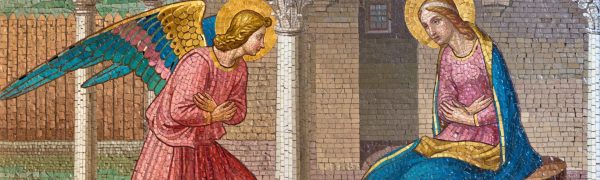
The angel Gabriel was sent from God
to a town of Galilee called Nazareth,
to a virgin betrothed to a man named Joseph,
of the house of David,
and the virgin’s name was Mary.
And coming to her, he said,
“Hail, full of grace! The Lord is with you.”
But she was greatly troubled at what was said
and pondered what sort of greeting this might be.
Then the angel said to her,
“Do not be afraid, Mary,
for you have found favor with God.
Behold, you will conceive in your womb and bear a son,
and you shall name him Jesus.
He will be great and will be called Son of the Most High,
and the Lord God will give him the throne of David his father,
and he will rule over the house of Jacob forever,
and of his Kingdom there will be no end.”
But Mary said to the angel,
“How can this be,
since I have no relations with a man?”
And the angel said to her in reply,
“The Holy Spirit will come upon you,
and the power of the Most High will overshadow you.
Therefore the child to be born
will be called holy, the Son of God.
And behold, Elizabeth, your relative,
has also conceived a son in her old age,
and this is the sixth month for her who was called barren;
for nothing will be impossible for God.”
Mary said, “Behold, I am the handmaid of the Lord.
May it be done to me according to your word.”
Then the angel departed from her.

– – –

Lectionary for Mass for Use in the Dioceses of the United States, second typical edition, Copyright © 2001, 1998, 1997, 1986, 1970 Confraternity of Christian Doctrine; Psalm refrain © 1968, 1981, 1997, International Committee on English in the Liturgy, Inc. All rights reserved. Neither this work nor any part of it may be reproduced, distributed, performed or displayed in any medium, including electronic or digital, without permission in writing from the copyright owner.

Daily Meditation


Saint of the Day


St. John of Damascus

St. John of Damascus

Feast date: Dec 04
Catholics remember and celebrate the life of the great Arab Church Father St. John of Damascus on Dec. 4.Eastern Orthodox Christians and Eastern Catholics, whose tradition has been particularly shaped by his insights, celebrate the saint’s feast on the same day as the Roman Catholic Church.Among Eastern Christians, St. John (676-749) is best known for his defense of Christian sacred art, particularly in the form of icons. While the churches of Rome and Constantinople were still united during St. John’s life, the Byzantine Emperor Leo III broke radically from the ancient tradition of the church, charging that the veneration of Christian icons was a form of idolatry.John had grown up under Muslim rule in Damascus, as the child of strongly Christian parents. His excellent education – particularly in theology – prepared him well to defend the tradition of sacred iconography, against the heresy of the “iconoclasts,” so-called because they would enter churches and destroy the images therein.During the 720s, the upstart theologian began publicly opposing the emperor’s command against sacred images in a series of writings. The heart of his argument was twofold: first, that Christians did not actually worship images,  but rather, through them they worshiped God, and honored the memory of the saints. Second, he asserted that by taking an incarnate physical form, Christ had given warrant to the Church’s depiction of him in images.By 730, the young public official’s persistent defense of Christian artwork had made him a permanent enemy of the emperor, who had a letter forged in John’s name offering to betray the Muslim government of Damascus. The ruling caliph of the city, taken in by the forgery, is said to have cut off John’s hand. The saint’s sole surviving biography states that the Virgin Mary acted to restore it miraculously. John eventually managed to convince the Muslim ruler of his innocence, before making the decision to become a monk and later a priest.Although a number of imperially-convened synods condemned John’s advocacy of Christian iconography, the Roman church always regarded his position as a defense of apostolic tradition. Years after the priest and monk died, the Seventh Ecumenical Council vindicated his orthodoxy, and ensured the permanent place of holy images in both Eastern and Western Christian piety.St. John of Damascus’ other notable achievements include the “Exact Exposition of the Orthodox Faith,” a work in which he systematized the earlier Greek Fathers’ thinking about theological truths in light of philosophy. The work exerted a profound influence on St. Thomas Aquinas and subsequent scholastic theologians. Centuries later, St. John’s sermons on the Virgin Mary’s bodily assumption into heaven were cited in Pope Pius XII’s dogmatic definition on the subject.The saint also contributed as an author and editor, to some of the liturgical hymns and poetry that Eastern Orthodox and Eastern Catholics still use in their celebrations of the liturgy.“Show me the icons that you venerate, that I may be able to understand your faith.” – Saint John of Damascus