

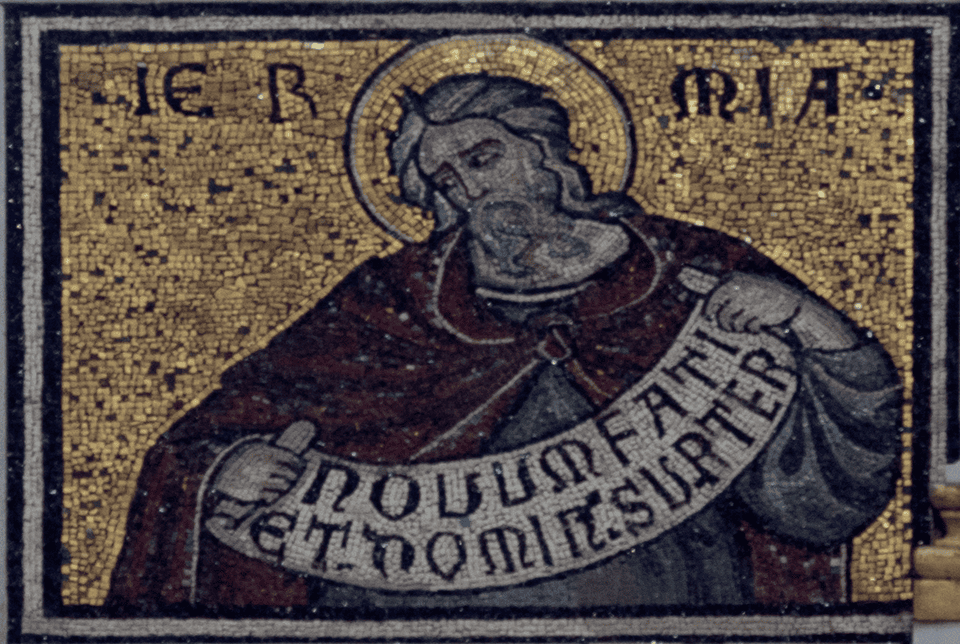
Today we hear a very interesting exchange between the prophet Hananiah and the prophet Jeremiah. Hananiah prophesies that Israel will be freed from Nebuchadnezzar. Jeremiah does not rebuke him; rather, he says that he too would like to see Israel freed, and cautions the people that a prophet of peace must not be believed frivolously. His prophecy must be borne out in history.
What can we learn from this? There are plenty of modern people who promise good things with a questionable foundation. Looking at Jeremiah’s example, we see that the proper response is not necessarily to start a heated debate. Jeremiah was not looking to intensify the environment; he was speaking the truth in a respectful and charitable way.
That being said, it’s clear that Jeremiah’s truth-telling is not lacking in courage. He leads with respect, sharing in Hananiah’s joy. Then he does not shy away from warning the people who have just been promised such a good thing: Be cautious of a prophet of peace, at least until the prophecy takes place.
Apparently Hananiah takes offense at this — Jeremiah’s civility is still a challenge to his own authority. Yet Jeremiah’s behavior continues to impress and to be a model for our own. What does he do when Hananiah takes his yoke from his neck and breaks it? Nothing. He allows him to speak, and he leaves.
It is “some time after” that Jeremiah receives word from the Lord that Hananiah was wrong. Notice that Jeremiah is far removed from the original situation. He had every opportunity to be offended in return and to inveigh against Hananiah. He didn’t. He remained respectful, did not back away from his urge to caution, and left. And then he waited for the Lord to speak.
Evidently, Hananiah did not do this. He either did not wait for the Lord to speak or did not recognize Him when He did. Or he ignored the Lord completely. Which led to a hasty proclamation of peace. Jeremiah spoke what he knew to be true, his message of gladness for peace and yet prudence at the prophet who proclaimed it, and then he stepped back and listened. As his reward, he received a message from God with the truth, and communicated that truth.
Aside from the obvious lessons we can learn about speaking up for and defending the faith, there is also the lesson to be sure that the Lord has spoken to us before we presume to speak for Him. We have been given a baptismal prophetic office, and yet that does not give us license to claim that everything we say is from the mouth of God. As Jeremiah was cautious and ultimately was still able to speak on God’s behalf, we too are watchful and are grateful when God does give us a message to share with others.
Hoy escuchamos un intercambio muy interesante entre el profeta Hananías y el profeta Jeremías. Hananías profetiza que Israel será liberado de Nabucodonosor. Jeremías no lo reprende; más bien, dice que a él también le gustaría ver a Israel liberado, y advierte al pueblo que no se debe creer frívolamente a un profeta de paz. Su profecía debe verse confirmada por la historia.
¿Qué podemos aprender de esto? Hay muchas personas en la actualidad que prometen cosas buenas, pero sobre cimientos cuestionables. Al observar el ejemplo de Jeremías, vemos que la respuesta adecuada no consiste necesariamente en iniciar un debate acalorado. Jeremías no buscaba crispar el ambiente; hablaba la verdad de una manera respetuosa y caritativa.
Dicho esto, está claro que a la franqueza de Jeremías no le falta valentía. Él actúa con respeto, compartiendo la alegría de Hananías. Luego, no rehúye advertir al pueblo —al que se le acaba de prometer algo tan bueno—: tengan cuidado con un profeta de paz, al menos hasta que la profecía se cumpla.
Al parecer, Hananías se ofende por esto; la civilidad de Jeremías sigue suponiendo un desafío a su propia autoridad. Sin embargo, el comportamiento de Jeremías continúa impresionando y sirviendo de modelo para el nuestro. ¿Qué hace él cuando Hananías le quita el yugo del cuello y lo rompe? Nada. Le permite hablar y se retira.
Es “un tiempo después” cuando Jeremías recibe la palabra del Señor confirmando que Hananías estaba equivocado. Nótese que Jeremías se encuentra ya muy alejado de la situación original. Tenía toda la oportunidad de ofenderse a su vez y de arremeter contra Hananías. Pero no lo hizo. Se mantuvo respetuoso, no renunció a su impulso de advertir y se marchó. Y entonces esperó a que el Señor hablara.
Evidentemente, Hananías no hizo esto. O bien, no esperó a que el Señor hablara, o no lo reconoció cuando lo hizo. O tal vez ignoró al Señor por completo. Lo cual condujo a una proclamación de paz precipitada. Jeremías habló lo que sabía que era verdad —su mensaje de alegría ante la paz, pero a la vez de prudencia respecto al profeta que la proclamaba—, y luego dio un paso atrás y escuchó. Como recompensa, recibió un mensaje de Dios con la verdad, y comunicó esa verdad.
Más allá de las lecciones evidentes que podemos aprender sobre alzar la voz en defensa de la fe, existe también la lección de asegurarnos de que el Señor nos ha hablado antes de presumir de hablar en Su nombre. Se nos ha conferido un oficio profético bautismal; sin embargo, esto no nos otorga licencia para afirmar que todo cuanto decimos proviene de la boca de Dios. Así como Jeremías actuó con cautela —y, a fin de cuentas, pudo hablar en nombre de Dios—, nosotros también nos mantenemos vigilantes y agradecidos cuando Dios nos confía un mensaje para compartir con los demás.
 David Dashiell is a freelance author, editor, and publisher in Hawaii. He has three children, a degree in theology, and enjoys writing poetry and discussing philosophy, culture, music, theology, and comedy. You can find his poetry blog, Poems at Twilight, on Substack, his publishing company, Ether Press, here, and his personal website here.
Feature Image Credit: Public Domain, commons.wikimedia.org/wiki/File:FlorenceBaptistery_Jeremiah.png
The views and opinions expressed in the Inspiration Daily blog are solely those of the original authors and contributors. These views and opinions do not necessarily represent those of Diocesan, the Diocesan staff, or other contributors to this blog.
Daily Reading

Feast of Saint Bartholomew, Apostle
Reading 1 Revelation 21:9b-14 The angel spoke to me, saying,“Come here.I will show you the bride, the wife of the Lamb.”He took me in spirit to a great, high mountainand…
Saint of the Day
Saint Bartholomew the Apostle
Saint Bartholomew, one of the Twelve Apostles, preached across Mesopotamia, Persia, Armenia, and beyond, spreading the Gospel widely. The post Saint Bartholomew the Apostle appeared first on uCatholic.