

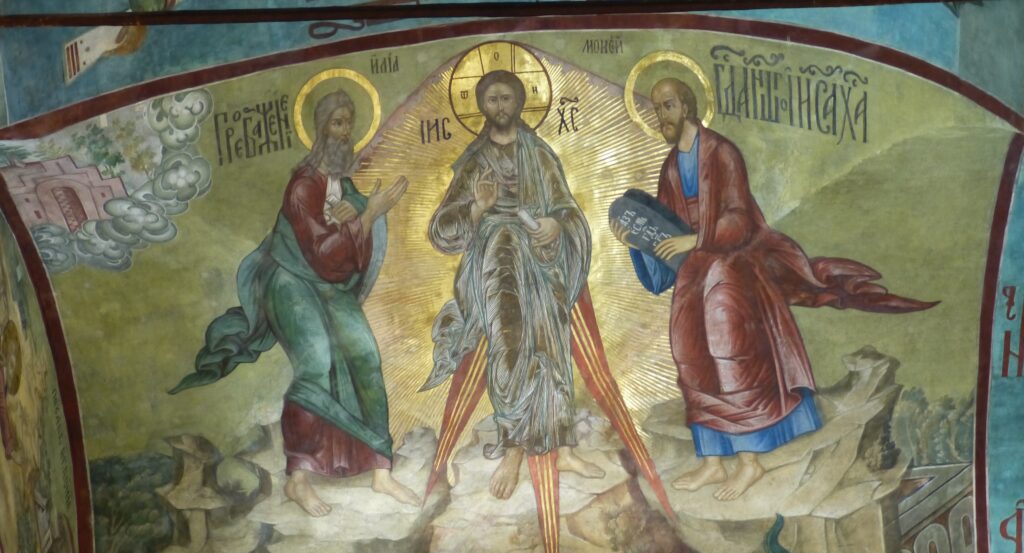
Today’s readings describe events that are difficult for us to imagine: Daniel’s burning bright vision of God, the Son of man coming on the clouds of heaven to receive everlasting glory and kingship, mountains melting “like wax before the Lord”, Jesus on a high mountain shining like the sun accompanied by Moses and Elijah, and the voice of the Father coming from a cloud.
In Scripture, mountains are often sacred places where Heaven and earth meet, places where divine encounters happen (think Mounts Moriah, Sinai, Carmel, and more). Jesus ascended mountains to pray in solitude, or to teach (the Sermon on the Mount), or to perform miracles. It was up on a high mountain that Jesus was transfigured, with Peter, James, and John as witnesses.
In this moment on the mountain, the Apostles “were very much afraid”. They were immersed in a Trinitarian experience that overwhelmed them, bowed low before a mystery they could not process fully. In the presence of the glory and the bright cloud, of Moses and Elijah, they fell prostrate in awe and fear, until Jesus touched them and they dared to raise their eyes again. They could not have understood the full meaning of what was happening, nor could they comprehend Jesus’ command to keep it to themselves “until the Son of Man has been raised from the dead.”
They could not have known that this experience would give them a cosmic context for what they were soon to witness: the brutal execution of the Lord they had given up everything to follow. As they walked back down the mountain, they could not foresee that this was a kind of preparation, that this vision would sustain them from Good Friday through to the Resurrection. They had been given a glimpse of Christ’s future glory and its true continuity with the Old Testament Covenant in this blinding vision – this event would later allow them to see Jesus’ horrific suffering and death as the culmination of God’s Plan of Salvation, begun in the primordial Garden, carried in the Law and the Prophets, fulfilled by Christ, and destined to last forever.
Sometimes, we are also given glimpses into the truth, beauty, and goodness of God. In brief moments, the Lord can give us clarity, peace, a sense of our belovedness, a certainty of the “rightness” of things. We rest in those moments in gratitude and praise, and they make us ready and open to accept His will in our lives. We can see these as spiritual “mountaintop experiences”.
But we must descend from our mountaintop experience, back to the valley of shadows, and even to Mount Calvary’s apparent defeat. In these low moments, the certainty of God’s love and power that we received on the mountain can strengthen our faith and hope, sustaining an eternal perspective.
Whether we are experiencing the nearness of God’s presence on the mountain or straining to make sense of His will in the valley, we must continually remember the Father’s directive: “Listen to him.”
Las lecturas de hoy describen acontecimientos que nos resultan difíciles de imaginar: la visión resplandeciente de Dios que tuvo Daniel, el Hijo del Hombre viniendo sobre las nubes del cielo para recibir gloria y realeza eternas, las montañas derritiéndose “como cera ante el Señor”, Jesús en una alta montaña brillando como el sol, acompañado por Moisés y Elías, y la voz del Padre que surge de una nube.
En las Escrituras, las montañas son a menudo lugares sagrados donde el Cielo y la tierra se encuentran; lugares donde tienen lugar encuentros divinos (pensemos en los montes Moria, Sinaí, Carmelo y otros más). Jesús subía a las montañas para orar en soledad, para enseñar (el Sermón de la Montaña) o para realizar milagros. Fue en la cima de una alta montaña donde Jesús se transfiguró, teniendo como testigos a Pedro, Santiago y Juan.
En aquel momento en la montaña, los apóstoles estuvieron “llenos de un gran temor”. Estaban inmersos en una experiencia trinitaria que los sobrecogió; se postraron humildemente ante un misterio que no lograban asimilar plenamente. Ante la presencia de la gloria y de la nube resplandeciente, de Moisés y de Elías, cayeron postrados, llenos de asombro y temor, hasta que Jesús los tocó y se atrevieron a alzar la vista de nuevo. No podían haber comprendido el significado pleno de lo que estaba ocurriendo, ni tampoco podían entender la orden de Jesús de guardar silencio al respecto “hasta que el Hijo del hombre haya resucitado de entre los muertos”.
No podían haber sabido que esa experiencia les proporcionaría un contexto cósmico para lo que pronto habrían de presenciar: la brutal ejecución del Señor, quien, para seguirlo, habían dejado todo. Mientras descendían de la montaña, no podían prever que esa experiencia constituía una especie de preparación; que esa visión los sostendría desde el Viernes Santo hasta la Resurrección. En esa visión deslumbrante se les había concedido un atisbo de la gloria futura de Cristo y de su verdadera continuidad con la Alianza del Antiguo Testamento; un acontecimiento que, más tarde, les permitiría contemplar el terrible sufrimiento y la muerte de Jesús como la culminación del Plan de Salvación de Dios: iniciado en el Jardín de Edén, anunciado en la Ley y los Profetas, cumplido por Cristo y destinado a perdurar por siempre.
A veces, también a nosotros se nos conceden atisbos de la verdad, la belleza y la bondad de Dios. En breves instantes, el Señor puede concedernos claridad, paz, un sentido de ser amados y la certeza de que las cosas son “como deben ser”. En esos momentos descansamos con gratitud y alabanza, y ellos nos preparan y nos abren a aceptar Su voluntad en nuestras vidas. Podemos considerar estas experiencias espirituales como “momentos cumbres”.
Sin embargo, debemos descender de nuestra experiencia en la cima, de regreso al valle de las sombras, e incluso hacia la aparente derrota del Monte Calvario. En estos momentos de adversidad, la certeza del amor y del poder de Dios —que recibimos en la montaña— puede fortalecer nuestra fe y nuestra esperanza, sustentando así una perspectiva eterna.
Ya sea que estemos experimentando la cercanía de la presencia de Dios en la montaña, o esforzándonos por comprender Su voluntad en el valle, debemos recordar continuamente la instrucción del Padre: “Escúchenlo”.
 Kathryn Mulderink, MA, is married to Robert, Station Manager for Holy Family Radio. Together they have seven children (including Father Rob), and eleven grandchildren. She is President of the local community of Secular Discalced Carmelites and has published five books and many articles. Over the last 30 years, she has worked as a teacher, headmistress, catechist, Pastoral Associate, and DRE, and as a writer and voice talent for Catholic Radio. Currently, she serves the Church by writing and speaking, and by collaborating with various parishes and to lead others to encounter Christ and engage their faith. Her website is www.KathrynTherese.com
Feature Image Credit: falco, pixabay.com/photos/russia-church-orthodox-historical-1173258/
The views and opinions expressed in the Inspiration Daily blog are solely those of the original authors and contributors. These views and opinions do not necessarily represent those of Diocesan, the Diocesan staff, or other contributors to this blog.
Daily Reading

Wednesday of the Twenty-first Week in Ordinary Time
Reading 1 2 Thessalonians 3:6-10, 16-18 We instruct you, brothers and sisters,in the name of our Lord Jesus Christ,to shun any brotherwho walks in a disorderly wayand not according to…
Saint of the Day
Pope Saint Zephyrinus
The pontificate of this first third-century pope was to see a storm of heresy rage around the pontiff, who had to keep a firm hand on the tiller of Peter’s