
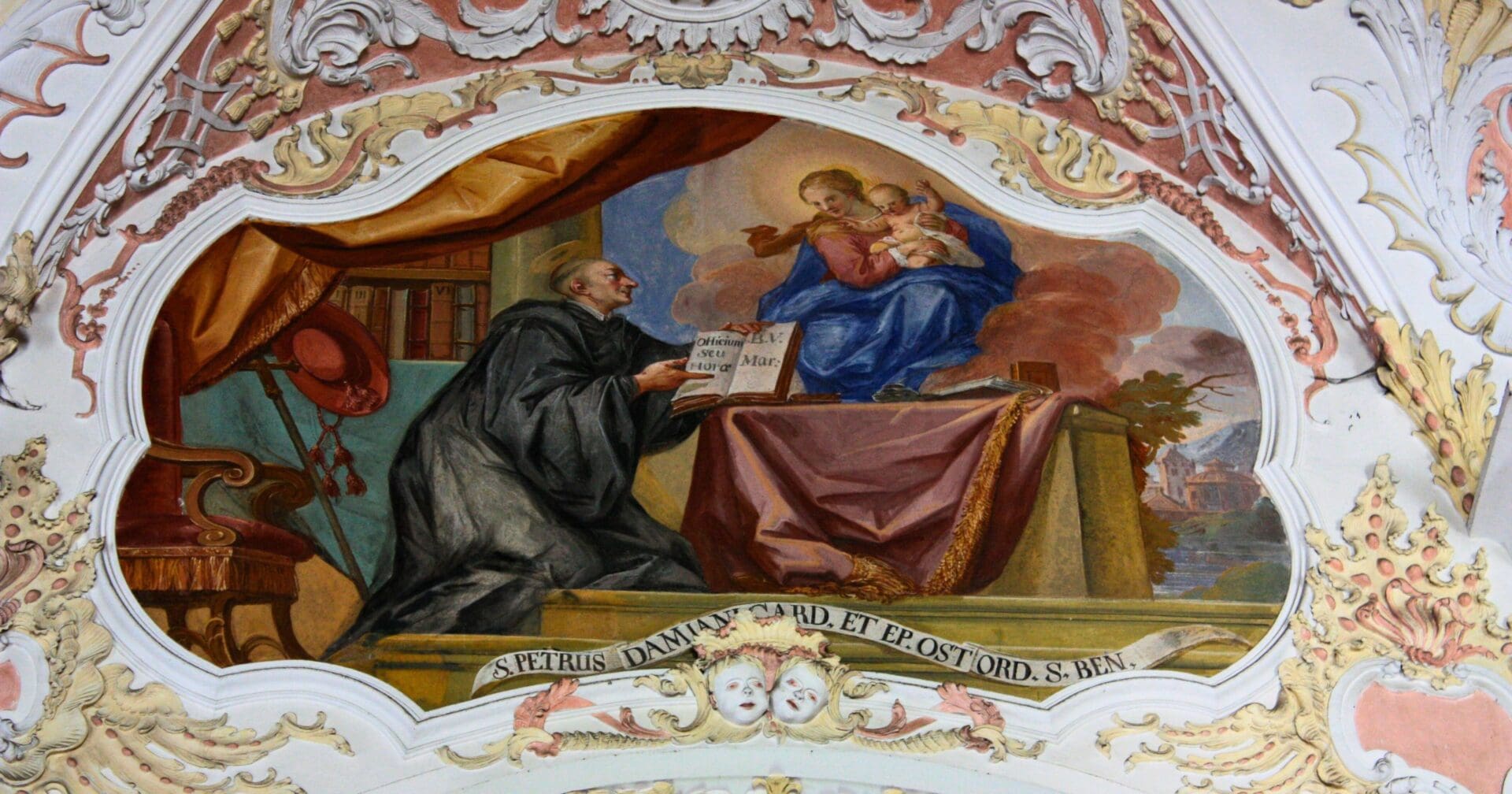
Saint Peter Damian, born in the year 988 into a noble yet impoverished family, was the youngest sibling among many. His arrival sparked such concern over the family’s limited resources that his mother initially refused to nurse him, nearly resulting in his death. Thankfully, a compassionate servant intervened, nourishing the infant and guiding his mother back to her maternal responsibilities. After losing his parents at a young age, Peter experienced a challenging childhood; initially taken in by an elder brother who mistreated him and made him tend to swine. However, his fortunes changed when another brother, an archpriest in Ravenna, took him under his care, providing Peter with an education and eventually leading him to become a professor.
Peter Damian was known for his ascetic practices from early on, including wearing a hair shirt, fasting extensively, and dedicating long hours to prayer. His deep spiritual dedication led him to join the Benedictines under the reformative vision of St. Romuald at Fonte Avellana, where monks lived in pairs within hermitages. Peter’s zeal for prayer was so intense that it resulted in significant insomnia, teaching him the importance of self-care alongside his spiritual commitments. Beyond prayer, he immersed himself in Biblical studies.
When the abbot of Fonte Avellana passed away, Peter was appointed his successor, going on to establish five additional hermitages. He fostered a contemplative life among his fellow monks, valuing solitude and prayer above all. Despite his preference for a reclusive life, the Church frequently sought his diplomatic skills for resolving conflicts within its ranks or with secular authorities.
His reputation for integrity and zeal caught the attention of Pope Stephen IX, who appointed him as the cardinal-bishop of Ostia. In this role, Peter Damian fought against the corrupt practice of simony, advocated for clerical celibacy, and encouraged communal life and regular religious observance among clergy. He championed a return to the austere discipline of the early Church, critiquing any laxity in religious practice, even addressing minor infractions such as sitting during the singing of psalms.
Peter Damian was a prolific writer, leaving behind a significant corpus including 170 letters, 53 sermons, and several biographies that preferred narrative over theoretical exposition. His contributions to liturgical writing also showcased his mastery of Latin.
Despite his influential position, Peter often requested to return to monastic life, a wish that was eventually granted by Pope Alexander II. Yet, even in retirement, he continued to serve the Church as a papal legate. On a return journey from such a mission in Ravenna, he succumbed to a fever and passed away on February 22, 1072, surrounded by monks reciting the Divine Office. In 1828, he was declared a Doctor of the Church.
Photo credit: Public Domain via Wikimedia Commons

The post Saint Peter Damian, Doctor of the Church appeared first on uCatholic.
Daily Reading

Monday of the Fifth Week of Lent
Reading I Daniel 13:1-9, 15-17, 19-30, 33-62 or 13:41c-62 In Babylon there lived a man named Joakim,who married a very beautiful and God-fearing woman, Susanna,the daughter of Hilkiah;her pious parents…
Daily Meditation

Jesus’ Timing
Click here for daily readings Jesus loved Mary, Martha, and Lazarus, so He waited. This is such a difficult passage to swallow. Like Martha who cries to Jesus, “Lord, if…