
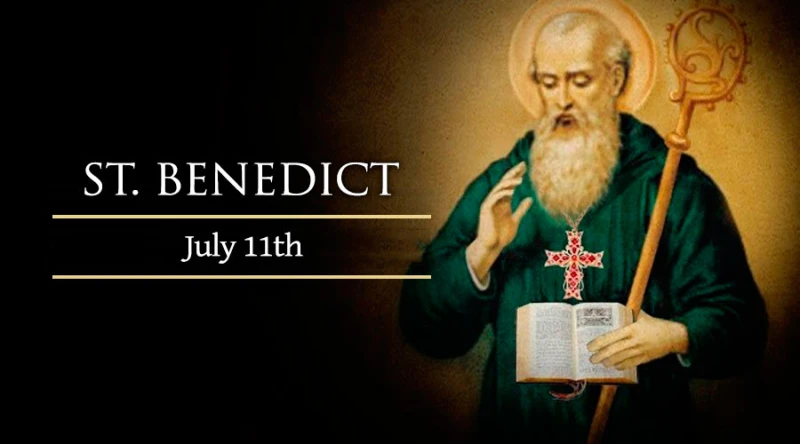
St. Benedict
Feast date: Jul 11
On July 11, the Catholic Church celebrates the feast of Saint Benedict of Nursia, the sixth-century abbot who gave Christian monasticism its lasting foundation in Western Europe.
For his historic role as the “Father of Western Monasticism,” St. Benedict was declared a co-patron of Europe (along with Saints Cyril and Methodius). St. Benedict is also the patron saint of Pope Benedict XVI’s pontificate.
In a 2005 general audience, Pope Benedict XVI said St. Benedict was a “powerful reminder of the indispensable Christian roots” of Europe. He cited the monk’s instruction to “prefer nothing to the love of Christ,” and asked his intercession “to help us keep Christ firmly at the heart of our lives.”
Born to upper-class parents in modern-day Italy during the year 480, Benedict was sent to Rome to study the humanities. However, he soon became disgusted with the loose morals that prevailed among the students. Withdrawing from the city, he lived briefly with a group of monks, then as a hermit.
The young man spent three years in solitude, facing and overcoming severe temptations through prayer and asceticism. Only after doing so, did he have the confidence to emerge as an organizer of monastic communities. His first monasteries were established in the Anio valley outside Subiaco.
Benedict’s monasteries in Subiaco became centers of education for children, a tradition which would continue in the order during his lifetime and beyond. His monastic movement, like its forebears in the Christian East, attracted large numbers of people who were looking to live their faith more deeply.
During 529, Benedict left Subiaco for Monte Cassino, 80 miles south of Rome. The move was geographically and spiritually significant, marking a more public emergence of the Western monastic movement. Benedict destroyed a pagan temple atop the mountain, and built two oratories in its place.
It was most likely at Monte Cassino that the abbot drew up a rule of life, the famous “Rule of St. Benedict,” which emphasised prayer, work, simplicity, and hospitality. Though known as a rule for monks, it is addressed to all those who seek “to do battle for Christ the Lord, the true King.”
Benedict’s life was marked by various intrigues and miraculous incidents, which are described in his biography written by Pope St. Gregory the Great. One of the most remarkable was his meeting in 543 with Totila, King of the Goths, in which the abbot rebuked the king’s lifestyle and prophesied his death.
St. Scholastica, Benedict’s sister, also embraced religious life as a nun. She most likely died shortly before him, around the year 543. In his final years, the abbot himself had a profound mystical experience, which is said to have involved a supernatural vision of God and the whole of creation.
Around the age of 63, Benedict suffered his final illness. He was carried into the church by his fellow monks, where he received the Eucharist for the last time. Held up by his disciples, he raised his hands in prayer for the last time, before dying in their arms.
Although his influence was primarily felt in Western Europe, St. Benedict is also celebrated by the Eastern Catholic churches, and by Eastern Orthodox Christians, on March 14.
Daily Reading

Friday of the First Week in Ordinary Time
Reading I 1 Samuel 8:4-7, 10-22a All the elders of Israel came in a body to Samuel at Ramahand said to him, “Now that you are old,and your sons do…
Daily Meditation

Whole Again
Click here for daily readings “Which is easier, to say to the paralytic, ‘Your sins are forgiven,’ or to say, ‘Rise, pick up your mat, and walk’?” This is Christ’s…