
Have you ever been falsely accused and felt you did nothing to deserve the blame? In today’s Gospel, one criminal rebuked another, saying, “Have you no fear of God, for you are subject to the same condemnation? And indeed, we have been condemned justly…but this man has done nothing criminal.” What reaction do you have when faced with false accusations? Anger? Denial? Frustration? Hopelessness? Acceptance? In this Gospel, Jesus and the redeemed criminal provide a great example of how to handle adversity when a situation hits you hard.
Jesus was nearing the end of His time here on earth, yet He focused on saving one more soul before reuniting with the Father. This selfless act shows us that regardless of life’s circumstances, there will always be someone there to help us through. That Someone is Jesus Christ. The redeemed criminal knew he would be together with Jesus in heaven because of His words. Then he spent time in sacred silence, letting the love and mercy of God wash over him.
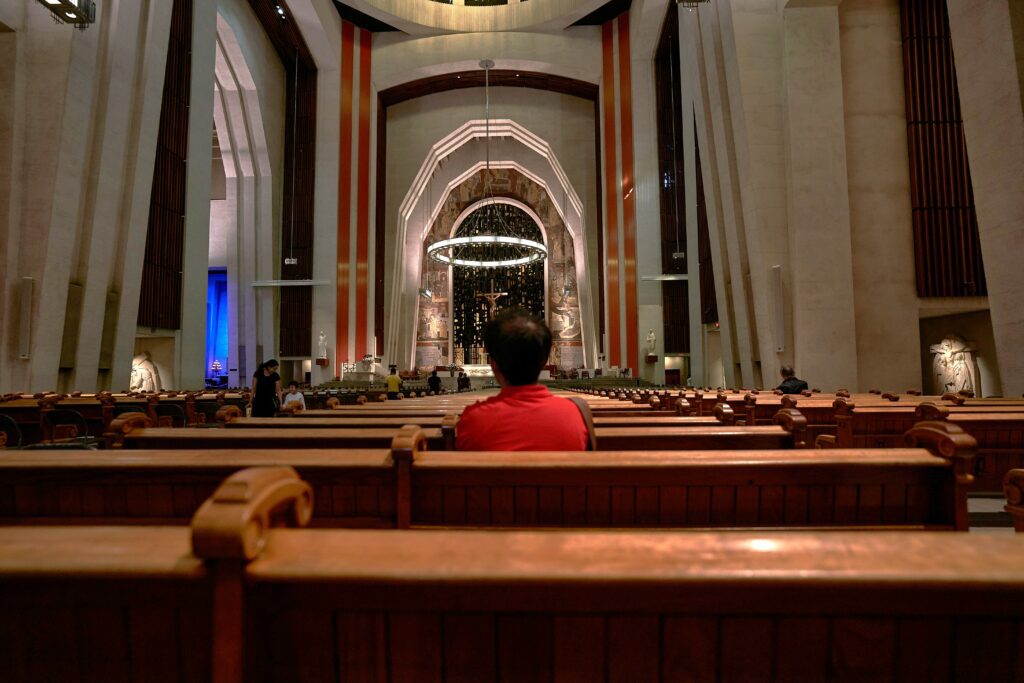
When do we experience sacred silence? We see several examples within the Mass. During the Penitential Act, we silently acknowledge our sins. Immediately after that, the Priest says, “Let us pray,” and the momentary silence serves as a doorway for us to speak to the Lord and for Him to fill us with His love and mercy. After the homily, we also take a moment of silence. I always ask the Lord to fill my heart and soul with the wisdom from the Gospel and the priest’s words.
Do you experience sacred silence in your daily life? How does it feel within you, and how do you accept it? Another example that comes to mind is sitting with Jesus in Adoration. When I spend an hour in silence it fills me with love, understanding, and a genuine connection with Him. I realize, though, that many times I miss the opportunity for silence and quickly move on to the next action I need to take.
Sacred silence is there when I realize that Jesus is always present, no matter what. He wants to tell me it will be alright, and to rely on Him and His will. It is when our hearts are united with His in a moment of pure love and there’s a peace that fills us. We cannot go wrong when we choose to spend time in sacred silence.
Daily Reading

Friday of the First Week of Advent
Reading 1 Isaiah 29:17-24 Thus says the Lord GOD: But a very little while, and Lebanon shall be changed into an orchard, and the orchard be regarded as a forest!…
Saint of the Day
St. John of Damascus
St. John of Damascus
Feast date: Dec 04
Catholics remember and celebrate the life of the great Arab Church Father St. John of Damascus on Dec. 4.Eastern Orthodox Christians and Eastern Catholics, whose tradition has been particularly shaped by his insights, celebrate the saint’s feast on the same day as the Roman Catholic Church.Among Eastern Christians, St. John (676-749) is best known for his defense of Christian sacred art, particularly in the form of icons. While the churches of Rome and Constantinople were still united during St. John’s life, the Byzantine Emperor Leo III broke radically from the ancient tradition of the church, charging that the veneration of Christian icons was a form of idolatry.John had grown up under Muslim rule in Damascus, as the child of strongly Christian parents. His excellent education – particularly in theology – prepared him well to defend the tradition of sacred iconography, against the heresy of the “iconoclasts,” so-called because they would enter churches and destroy the images therein.During the 720s, the upstart theologian began publicly opposing the emperor’s command against sacred images in a series of writings. The heart of his argument was twofold: first, that Christians did not actually worship images, but rather, through them they worshiped God, and honored the memory of the saints. Second, he asserted that by taking an incarnate physical form, Christ had given warrant to the Church’s depiction of him in images.By 730, the young public official’s persistent defense of Christian artwork had made him a permanent enemy of the emperor, who had a letter forged in John’s name offering to betray the Muslim government of Damascus. The ruling caliph of the city, taken in by the forgery, is said to have cut off John’s hand. The saint’s sole surviving biography states that the Virgin Mary acted to restore it miraculously. John eventually managed to convince the Muslim ruler of his innocence, before making the decision to become a monk and later a priest.Although a number of imperially-convened synods condemned John’s advocacy of Christian iconography, the Roman church always regarded his position as a defense of apostolic tradition. Years after the priest and monk died, the Seventh Ecumenical Council vindicated his orthodoxy, and ensured the permanent place of holy images in both Eastern and Western Christian piety.St. John of Damascus’ other notable achievements include the “Exact Exposition of the Orthodox Faith,” a work in which he systematized the earlier Greek Fathers’ thinking about theological truths in light of philosophy. The work exerted a profound influence on St. Thomas Aquinas and subsequent scholastic theologians. Centuries later, St. John’s sermons on the Virgin Mary’s bodily assumption into heaven were cited in Pope Pius XII’s dogmatic definition on the subject.The saint also contributed as an author and editor, to some of the liturgical hymns and poetry that Eastern Orthodox and Eastern Catholics still use in their celebrations of the liturgy.“Show me the icons that you venerate, that I may be able to understand your faith.” – Saint John of Damascus