Daily Reading


Daily Meditation


Daily Reading


Daily Meditation


Daily Reading


Daily Meditation


1/20

Keynote speakers at “The Beauty of Truth: Navigating Society Today as a Catholic Woman” conference, held Jan. 9-10, 2026, in Houston (left to right): Erika Bachiochi, Mary Eberstadt, Angela Franks, Pia de Solenni, and Leah Sargeant. | Credit: Photo courtesy of the University of St. Thomas

Daily Reading


Daily Meditation


1/20

Keynote speakers at “The Beauty of Truth: Navigating Society Today as a Catholic Woman” conference, held Jan. 9-10, 2026, in Houston (left to right): Erika Bachiochi, Mary Eberstadt, Angela Franks, Pia de Solenni, and Leah Sargeant. | Credit: Photo courtesy of the University of St. Thomas

Daily Reading


Daily Meditation


image

St. Vincent was Deacon of Saragossa, and a martyr under Diocletian in 304. This most renowned martyr of Spain is represented in the dalmatic of a deacon, and has as emblems a cross, a raven, a grate, or a fire-pile. He is honored as patron in Valencia, Saragossa and Portugal. Very little can be confirmed about his life.

By order of Governor Dacian, Vincent and his bishop were dragged in chains to Valencia and kept in prison there for a long time. Then Valerius was banished, but Vincent was subjected to many cruel torments including the rack, the gridiron, and scourgings. After suffering these, he was again imprisoned in a cell strewn with shards of broken pots. He was then placed in a soft and luxurious bed, to shake his constancy, but there he expired.

After peace was restored to the Church, a chapel was built over Vincent’s remains outside the walls of Valencia.

Daily Reading


Daily Meditation


image

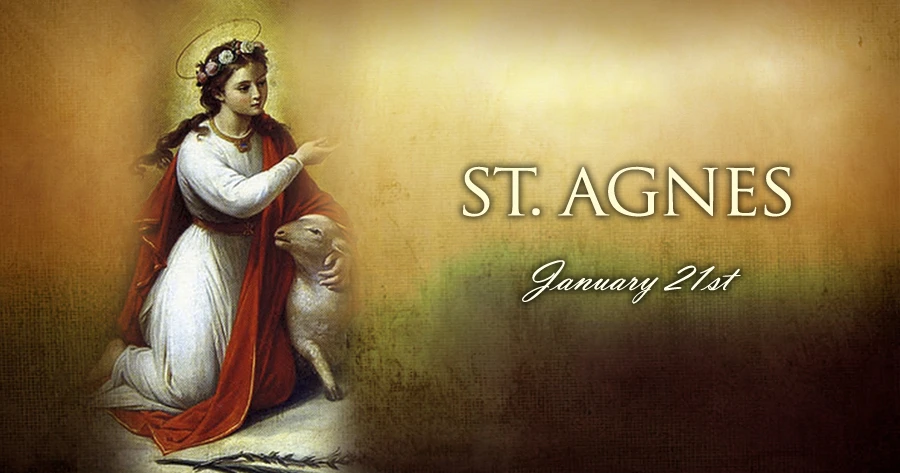
On Jan. 21, the Roman Catholic Church honors the virgin and martyr St. Agnes, who suffered death for her consecration to Christ.

Although the details of Agnes’ life are mostly unknown, the story of her martyrdom has been passed on with reverence since the fourth century. On the feast day of the young martyr – whose name means “lamb” in Latin – the Pope traditionally blesses lambs, whose wool will be used to make the white pallium worn by archbishops.

Born into a wealthy family during the last decade of the third century, Agnes lived in Rome during the last major persecution of the early Church under the Emperor Diocletian. Though he was lenient toward believers for much of his rule, Diocletian changed course in 302, resolving to wipe out the Church in the empire.

Agnes came of age as the Church was beginning to suffer under a set of new laws decreed by Diocletian, and his co-ruler Galerius, in 303. The emperor and his subordinate called for churches to be destroyed and their books burned. Subsequent orders led to the imprisonment and torture of clergy and laypersons, for the sake of compelling them to worship the emperor instead of Christ.

Meanwhile, Agnes had become a young woman of great beauty and charm, drawing the attention of suitors from the first ranks of the Roman aristocracy. But in keeping with the words of Christ and Saint Paul, she had already decided on a life of celibacy for the sake of God’s kingdom. To all interested men, she explained that she had already promised herself to a heavenly and unseen spouse.

These suitors both understood Agnes’ meaning, and resented her resolution. Some of the men, possibly looking to change her mind, reported her to the state as a believer in Christ. Agnes was brought before a judge who tried first to persuade her, and then to threaten her, into renouncing her choice not to marry for the Lord’s sake.

When the judge showed her the various punishments he could inflict – including fire, iron hooks, or the rack that destroyed the limbs by stretching – Agnes smiled and indicated she would suffer them willingly. But she was brought before a pagan altar instead, and asked to make an act of worship in accordance with the Roman state religion.

When Agnes refused, the judge ordered that she should be sent to a house of prostitution, where the virginity she had offered to God would be violated. Agnes predicted that God would not allow this to occur, and her statement proved true. Legends say that the first man to approach her in the brothel was struck blind by a sudden flash of light, and others opted not to repeat his mistake.

But one of the men who had at first sought to make Agnes his own, now lobbied the judge for her execution. In this respect, the suitor obtained his desire, when the public official sentenced her to die by beheading. The executioner gave her one last chance to spare her life, by renouncing her consecration to Christ – but Agnes refused, made a short prayer, and courageously submitted to death.

St. Agnes, who died in 304, was venerated as a holy martyr from the fourth century onward. She is mentioned in the Latin Church’s most traditional Eucharistic prayer, the Roman Canon.

Daily Reading


Daily Meditation


image

Sebastian was the son of a wealthy Roman family. He was educated in Milan and became an officer of the imperial Roman army, and Captain of the Guard. He was a favorite of Emperor Diocletian. During Diocletian’s persecution of the Christians, Sebastian visited them in prison, bringing both supplies and comfort. He is reported to have healed the wife of a fellow soldier by making the sign of the cross over her. During his time in the army he converted many soldiers and a governor.

Charged as a Christian in 288 in Rome, Sebastian was tied to a tree, shot with arrows, and left for dead. However, he survived, recovered, and returned to preach to Diocletian, where the emperor then had him beaten to death.

Daily Reading


Daily Meditation


image

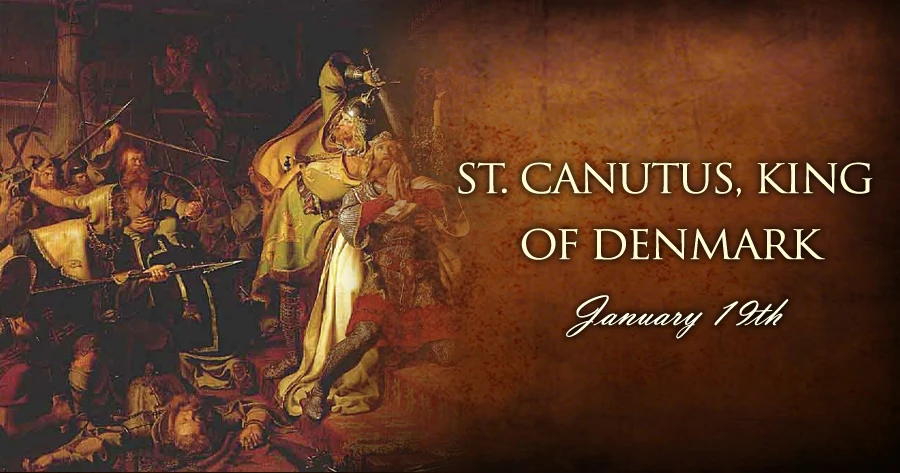
Saint Canutus, King of Denmark,  succeeded his elder brother Harold on the throne of Denmark in the year 1080. He began his reign by a successful war against the enemies of the state, and by planting the faith in the conquered provinces. Amid the glory of his victories he humbly prostrated himself at the foot of the crucifix, laying there his diadem, and offering himself and his kingdom to the King of kings. After having provided for the peace and safety of his country, he married Eltha, daughter of Robert, Earl of Flanders, who proved herself a spouse worthy of him.

The justice of Saint Canutus as sovereign was well known. He applied himself to the reform of all internal abuses. For this purpose he enacted severe but necessary laws for the strict administration of justice, the repression of violence and tyranny by the powerful, without respect to persons. He favored and honored holy men, and granted many privileges and immunities to the clergy. His charity and tenderness towards his subjects made him study all possible ways to make them a happy people.

During a rebellion in his kingdom, the king was surprised at church by the rebels. He confessed his sins and received Holy Communion. Stretching out his arms before the altar, he was struck down on his knees by the enemies of his Christian reign.

Daily Reading


Daily Meditation


.aligncenter { clear: both; display: block; margin-left: auto; margin-right: auto; }

A few more days and we will celebrate with great joy the birth of our Savior! We are told to look, see, pay attention, lift our heads, be alert, for a great messenger is coming who will point to the Savior.

In today’s Gospel, Elizabeth and Zechariah rejoice in naming their son John and right away neighbors are concerned and start discussing the whole situation, wondering “What, then, will this child be? For surely the hand of the Lord was with him.” 

John points us to Jesus. He never claims to be anything other than what he is. There is a lesson in that for all of us. Our world often confuses us. We admire people for so many reasons and look for their advice on how we are to live. They are often people who have fame and great wealth, but it sometimes seems like it is all smoke and mirrors, nothing substantial behind the façade of being popular or an influencer.

John was not concerned with being an influencer. I doubt that he tried to convince people to lose weight on the locust and wild honey eating plan or trade their linen clothes for ones of camel hair. He was concerned with the truth and leading others to Jesus. He called people to repentance so they would be ready for the Savior.

Which brings us to now. Today. Are you ready? Have you prepared yourself for the birth of Jesus? We have had four weeks of Advent and Christmas is upon us. If you think you had a less than stellar Advent, it is not too late. And this does not require any shopping or even leaving your house.

Go off to a quiet spot in your house. Open your Bible and read Luke Chapter 1 and Chapter 2, verses 1-38. There are a few canticles in that section and prayers of thanksgiving. Pray those slowly. And then sit for ten minutes or so and allow God’s peace to fill you. Then, write out a prayer of praise and thanks for all you have received this past year. You may find your Christmas is much more full of rejoicing. 

Contact the author


¡En pocos días celebraremos con gran alegría el nacimiento de nuestro Salvador! Se nos dice que miremos, veamos, prestemos atención, alcemos la cabeza, estemos alertas, porque viene un gran mensajero que nos señalará al Salvador.

En el Evangelio de hoy, Isabel y Zacarías se alegran al nombrar a su hijo Juan, e inmediatamente los vecinos se preocupan y empiezan a comentar sobre la situación, preguntándose: “‘¿Qué va a ser de este niño?”… porque realmente la mano de Dios estaba con él”.

Juan nos señala a Jesús. Nunca dice ser otra cosa de lo que es. Hay una lección en esto para todos nosotros. Nuestro mundo a menudo nos confunde. Admiramos a las personas por muchas razones y buscamos su consejo sobre cómo debemos vivir. A menudo son personas famosas y ricas, pero a veces parece que todo es humo y espejos, nada sustancial tras la fachada de ser popular o influyente.

A Juan no le preocupaba ser influyente. Dudo que intentara convencer a la gente bajar de peso con la dieta de langosta y miel silvestre, o de cambiar sus ropas de lino por otras de pelo de camello. Se ocupaba de la verdad y de guiar a otros a Jesús. Llamaba a la gente al arrepentimiento para que estuvieran listos para el Salvador.

Y eso nos lleva al día presente. Hoy. ¿Estás listo? ¿Te has preparado para el nacimiento de Jesús? Hemos tenido cuatro semanas de Adviento y ya se acerca la Navidad. Si crees que tuviste un Adviento decepcionante, aún tienes tiempo. Y esto no requiere irte de compras o ni siquiera salir de casa.

Encuentra un lugar tranquilo en tu casa. Abre tu Biblia y lee Lucas capítulo 1 y capítulo 2 versículos 1-38. Hay unos cánticos en esa sección y oraciones de acción de gracias. Reza lentamente. Luego, siéntate unos diez minutos y deja que la paz de Dios te llene. Luego, escribe una oración de alabanza y agradecimiento por todo lo que has recibido este año. Puede que tu Navidad esté mucho más llena de regocijo.

Comunicarse con la autora

Deanna G. Bartalini, M.Ed.; M.P.A., is a certified spiritual director, writer, speaker and content creator. The LiveNotLukewarm.com online community is a place to inform, engage and inspire your Catholic faith. Her weekly Not Lukewarm Podcast gives you tips and tools to live out your faith in your daily life.

Feature Image Credit: Anuja Tilj, https://unsplash.com/photos/red-flower-in-white-ceramic-vase-5B6q-bgK-wQ

The views and opinions expressed in the Inspiration Daily blog are solely those of the original authors and contributors. These views and opinions do not necessarily represent those of Diocesan, the Diocesan staff, or other contributors to this blog.

Daily Reading


Saint of the Day