

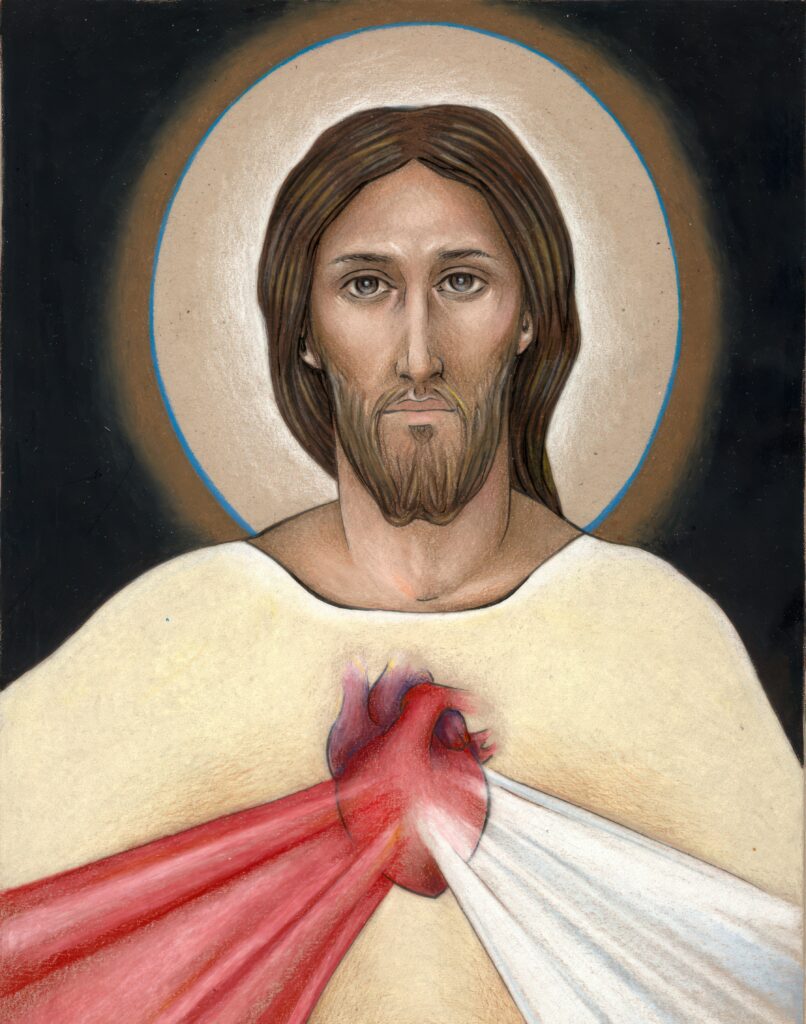
How I wish I could be Thomas at the moment when Jesus says, “Put your finger here and see my hands, and bring your hand and put it into my side” (John 20:27). Thomas touched Divine Mercy when he touched Christ’s side. Jesus invited him to put his hand into the very wound from which blood and water had flowed.
Jesus’ wounds have been transformed. They have been redeemed. They are not simply flesh wounds. They are the wounds of redemption and salvation. They are the wounds of love and mercy, from which grace is poured out to the world.
To St. Faustina, Jesus said, “From all My wounds, like from streams, mercy flows for souls, but the wound in My Heart is the fountain of unfathomable mercy. From this fountain spring all graces for souls…. I desire greatly to pour them out upon souls…” (Diary of St. Faustina, #1190).
What surge of love Thomas must have felt as he experienced this mercy! What an intimate encounter he must have had with our Lord! Jesus’ glorified wounds are not only transformed, they are transformative. They are not only redeemed, they are redemptive. Thomas’ heart must have been on fire as He realized the depths of Christ’s love and experienced the transformation and redemption Christ died to give us. With what passion must he have proclaimed, “My Lord and my God!” (John 20:28)
As with Thomas, often a sudden realization of God’s great love and mercy incites our worship and cracks our hearts open as well. By accepting the invitation to bring our doubts, pain, woundedness, and sinfulness to Him, approaching Him and seeing what He has done for us, surrendering ourselves to Him as we do, He can touch our hearts. It is communion with His limitless love that transforms us when we receive Our Lord and offer our hearts as His abode.
In a very powerful way, the wound in Christ’s side is the very passageway we are invited to travel to encounter His Heart. His wounds cannot be separated from Divine Mercy, for it is through His suffering and the giving of Himself, through His death and His wounds, especially the wound created by the spear driven into His Heart, that His merciful, redemptive work was released.
We can no longer physically put our hand into Christ’s wound as Thomas did. We are called to believe without seeing or touching. But we do have the gift of Divine Mercy and the gift of the Eucharist, in which we can have an equally powerful experience of Christ’s love and mercy, of redemption and transformation. This Divine Mercy Sunday, let us come to Our Lord. Let us pray to Him and venerate Him. Let us receive Him into our bodies. And let us cry out in worship and awe together with Thomas, “My Lord and my God!”
¡Cuánto desearía ser Tomás en el momento en que Jesús dice: “Aquí están mis manos; acerca tu dedo. Trae acá tu mano, métela en mi costado” (Juan 20,27)! Tomás tocó la Divina Misericordia cuando tocó el costado de Cristo. Jesús lo invitó a poner su mano en la misma herida de la que habían brotado sangre y agua.
Las llagas de Jesús han sido transformadas. Han sido redimidas. No son simplemente heridas físicas. Son las llagas de la redención y la salvación. Son las llagas del amor y la misericordia, de las cuales la gracia se derrama sobre el mundo.
A Santa Faustina, Jesús le dijo: “De todas mis llagas, como de arroyos, fluye misericordia para las almas, pero la herida de mi Corazón es la fuente de la misericordia insondable. De esta fuente brotan todas las gracias para las almas… Deseo ardientemente derramarlas sobre las almas…” (Diario de Santa Faustina, n.º 1190).
¡Qué oleada de amor debió sentir Tomás al experimentar esta misericordia! ¡Qué encuentro tan íntimo debió tener con nuestro Señor! Las llagas glorificadas de Jesús no solo están transformadas, sino que son transformadoras. No solo están redimidas, sino que son redentoras. El corazón de Tomás debió arder al comprender la profundidad del amor de Cristo y experimentar la transformación y la redención que Cristo murió para darnos. ¡Con qué pasión debió proclamar: “¡Señor mío y Dios mío!” (Juan 20,28)!
Al igual que con Tomás, a menudo una comprensión repentina del gran amor y la misericordia de Dios incita nuestra adoración y abre nuestros corazones. Al aceptar la invitación a llevarle nuestras dudas, dolor, heridas y pecados, al acercarnos a Él y ver lo que ha hecho por nosotros, al entregarnos a Él, puede tocar nuestros corazones. Es la comunión con su amor ilimitado lo que nos transforma cuando recibimos a Nuestro Señor y ofrecemos nuestros corazones como su morada.
De una manera muy poderosa, la herida en el costado de Cristo es el mismo camino que estamos invitados a recorrer para encontrar su Corazón. Sus llagas no pueden separarse de la Divina Misericordia, pues es a través de su sufrimiento y de su entrega, a través de su muerte y sus llagas, especialmente la herida causada por la lanza clavada en su Corazón, que se manifestó su obra misericordiosa y redentora.
Ya no podemos tocar físicamente la herida de Cristo con nuestras manos, como hizo Tomás. Estamos llamados a creer sin ver ni tocar. Pero sí tenemos el don de la Divina Misericordia y el don de la Eucaristía, en los que podemos experimentar de una manera igualmente poderosa el amor y la misericordia de Cristo, la redención y la transformación. En este Domingo de la Divina Misericordia, acerquémonos a Nuestro Señor. Oremos a Él y venerémoslo. Recibámoslo en nuestros cuerpos. Y exclamemos con adoración y asombro, junto con Tomás: “¡Señor mío y Dios mío!”
 Kimberly Andrich writes from the perspective of having a hidden, chronic illness and experiencing a deep, continuous conversion through being yoked to Jesus in the day-to-day trials and joys of life. She is a wife, mother of 5, and daughter of the King. Kimberly also writes for Catholicmom.com and on fallingonhisgrace.substack.com.
Feature Image Credit: Elizabeth Stefanick, art.diocesan.com/stock-photo/divine-mercy-16720/
The views and opinions expressed in the Inspiration Daily blog are solely those of the original authors and contributors. These views and opinions do not necessarily represent those of Diocesan, the Diocesan staff, or other contributors to this blog.
Daily Reading

Second Sunday of Easter (or Sunday of Divine Mercy)
Reading 1 Acts 2:42-47 They devoted themselvesto the teaching of the apostles and to the communal life,to the breaking of bread and to the prayers.Awe came upon everyone,and many wonders…
Saint of the Day

Divine Mercy Sunday
During the course of Jesus’ revelations to Saint Faustina, He asked on numerous occasions that a feast day be dedicated to the Divine Mercy, celebrated on the Sunday after Easter.