

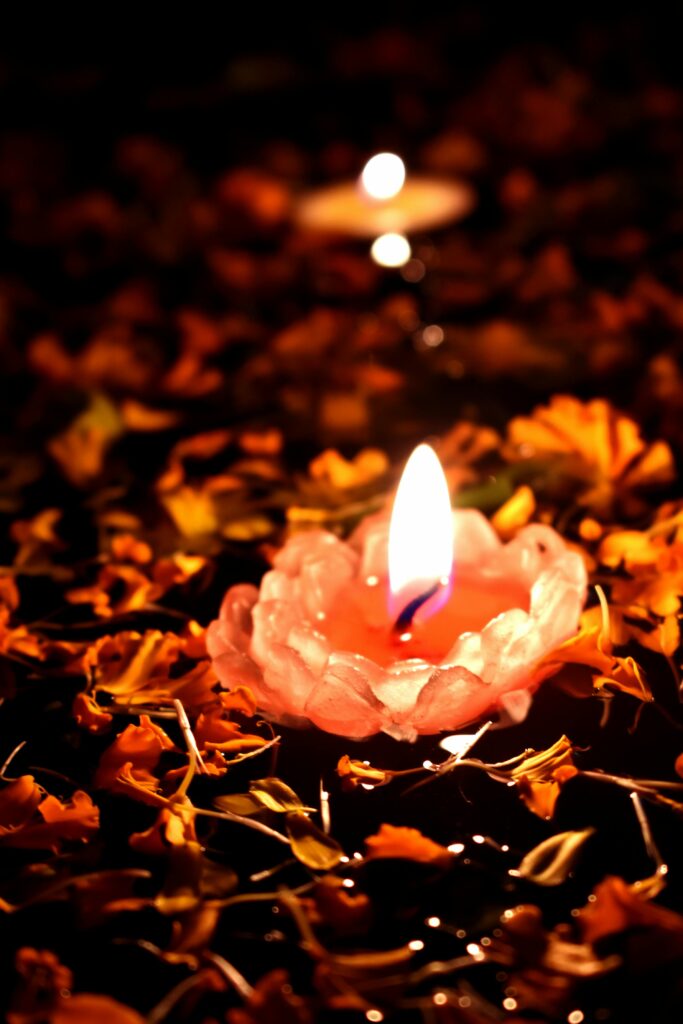
The third Sunday of Advent is called Gaudete (Rejoice) Sunday. I find the Gospel reading of the day particularly fitting, but especially the second half. Jesus asks His disciples who they went into the desert to see, namely, the messenger that He sent ahead of Himself, to prepare the way for His coming. I believe that the call of John the Baptist is also the call of all Christians, especially in this time when the world is so focused on creating division and sadness. There is a noticeable darkness spreading in the world. People are hurting and that hurt makes them sad, and the sadness makes them lonely and the cycle continues.
You may have heard the term “trauma dumping”, that is, sharing every negative thing that has happened in your life in hopes that someone will relate to you and help fix the hurt. But this has had an adverse effect where people try to ‘one up’ each other’s trauma experiences, which ultimately widens the void of loneliness when everyone realizes that no one will truly understand their personal hurt. I believe that this is a major contributor to the darkness that seems to loom over the world these days. John the Baptist undoubtedly had difficulties in life: he lived uncomfortably, he experienced loneliness in the desert, away from anything easy, yet people flocked to him. This leads me to believe that although his life remained difficult, he never sought to preach to people about his hardship, instead he had the joy of God and was excited to share His coming with everyone who listened.
I don’t want to discredit anyone who may have experienced particularly difficult things in life; those wounds are real and necessary in our fallen states, and sometimes the hurt never goes away. However, we can turn to the Lord for strength – the joy of the Lord is our strength. I’m the first to admit that sometimes wallowing in and holding on to our pain like a vice grip seems like the only safe thing to do when you’re in the midst of it. But when we turn to Him, place our pain into his pierced hands and let Him strengthen us, we cannot help but rejoice and share the joy of His word with everyone who listens.
This is how we can dispel the darkness that is taking over our world. Our wounds are what make us human, but through His strength, Christ heals, and the joy that follows helps us grow in holiness.
Daily Reading

Feast of Our Lady of Guadalupe
Reading 1 Zechariah 2:14-17 Sing and rejoice, O daughter Zion! See, I am coming to dwell among you, says the LORD. Many nations shall join themselves to the LORD on…
Saint of the Day
St. Juan Diego
St. Juan Diego
Feast date: Dec 09
On Dec. 9, Roman Catholics celebrate St. Juan Diego, the indigenous Mexican Catholic convert whose encounter with the Virgin Mary began the Church’s devotion to Our Lady of Guadalupe.In 1474, 50 years before receiving the name Juan Diego at his baptism, a boy named Cuauhtlatoatzin — “singing eagle” — was born in the Anahuac Valley of present-day Mexico. Though raised according to the Aztec pagan religion and culture, he showed an unusual and mystical sense of life even before hearing the Gospel from Franciscan missionaries.In 1524, Cuauhtlatoatzin and his wife converted and entered the Catholic Church. The farmer now known as Juan Diego was committed to his faith, often walking long distances to receive religious instruction. In December of 1531, he would be the recipient of a world-changing miracle.On Dec. 9, Juan Diego was hurrying to Mass to celebrate the Feast of the Immaculate Conception. But the woman he was heading to church to celebrate came to him instead.In the native Aztec dialect, the radiant woman announced herself as the “ever-perfect holy Mary, who has the honor to be the mother of the true God.”“I am your compassionate Mother, yours and that of all the people that live together in this land,” she continued, “and also of all the other various lineages of men.”She asked Juan Diego to make a request of the local bishop. “I want very much that they build my sacred little house here” — a house dedicated to her son Jesus Christ, on the site of a former pagan temple, that would “show him” to all Mexicans and “exalt him” throughout the world.She was asking a great deal of a native farmer. Not surprisingly, his bold request met with skepticism from Bishop Juan de Zumárraga. But Juan Diego said he would produce proof of the apparition, after he finished tending to his uncle whose death seemed imminent.Making his way to church on Dec. 12, to summon a priest for his uncle, Juan Diego again encountered the Blessed Virgin. She promised to cure his uncle and give him a sign to display for the bishop. On the hill where they had first met he would find roses and other flowers, though it was winter.Doing as she asked, he found the flowers and brought them back to her. The Virgin Mary then placed the flowers inside his tilma, the traditional cloak-like garment he had been wearing. She told him not to unwrap the tilma containing the flowers until he had reached the bishop.When he did, Bishop Zumárraga had his own encounter with Our Lady of Guadalupe – through the image of her that he found miraculously imprinted on the flower-filled tilma. The Mexico City basilica that now houses the tilma has become, by some estimates, the world’s most-visited Catholic shrine.The miracle that brought the Gospel to millions of Mexicans also served to deepen Juan Diego’s own spiritual life. For many years after the experience, he lived a solitary life of prayer and work in a hermitage near the church where the image was first displayed. Pilgrims had already begun flocking to the site by the time he died on Dec. 9, 1548, the 17th anniversary of the first apparition.Blessed John Paul II beatified St. Juan Diego in 1990, and canonized him in 2002.