
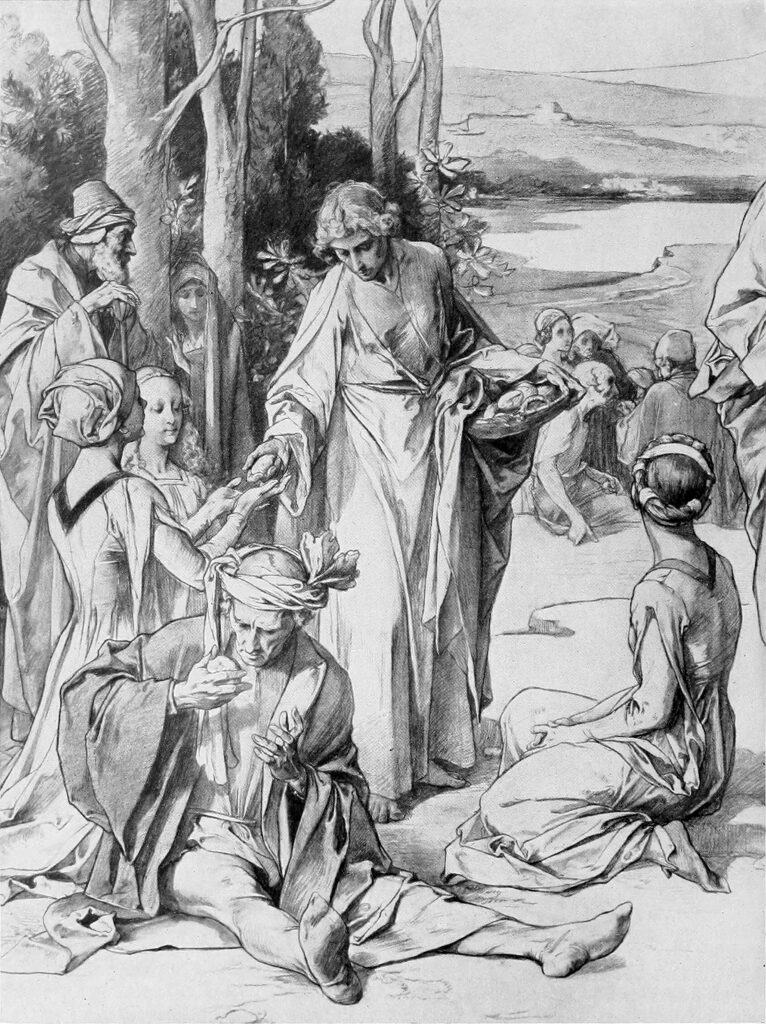
In today’s Gospel we learn the value of participating in the work of our Lord. We learn that even when Jesus has taken time to heal many people, there is work He wants to involve us in, things He wants to do for others. Jesus is concerned about the crowd, and He lets His disciples know of His concern. However, the disciples respond that there is no place to get food for so many people. Jesus ignores their concern. They are thinking in human terms, not God’s.
Jesus asks them what they have and takes it from them. They are looking outside of themselves. But Jesus changes their perspective by making them look for what He needs among themselves: “How many loaves do you have?”
How many times does Jesus show us someone that needs our help or something that He is calling us to, but we feel like the problem or task is too big to be solved by us? We say back to Him: “Impossible!” Then, Jesus asks us: “What do you have?” Reminding us that what we have been given is meant to be offered back to Him to fulfill His purpose. We are not expected to solve the big problem on our own or tackle the seemingly impossible task alone. If we offer it to Him, He will multiply our gift of self, time, money, etc. in order to help us achieve whatever He has called us to.
He will be grateful for the gifts we are now offering for others and multiply them in ways we cannot imagine. And once we continue giving all that He has multiplied until whatever or whoever is satisfied, He will have multiplied so much as to leave us with more than we had.
For when we give gifts to Jesus, we are never giving away all we had to give. We are instead trusting in His power and love and He turns our giving into receiving.
What happens with the seven baskets left over? We do not know. The Gospel simply tells us there was plenty left. We can assume it’s not left behind, wasted, or unused, but instead is shared with others during other parts of their journey or enjoyed by the disciples once the crowds have dispersed.
God makes it so we will continually have something to offer even when it feels like we have nothing that will solve the problem. When it seems like everyone is satisfied, we will be left with more than enough to satisfy ourselves and share with others in the future. Jesus constantly invites us to look inside ourselves and asks: “What do you have?” Then we have to ask ourselves whether or not we are willing to give what we have so that He can multiply it for the good of others.
Daily Reading

Thursday of the First Week of Advent
Reading I Isaiah 26:1-6 On that day they will sing this song in the land of Judah: “A strong city have we; he sets up walls and…
Saint of the Day
St. John of Damascus
St. John of Damascus
Feast date: Dec 04
Catholics remember and celebrate the life of the great Arab Church Father St. John of Damascus on Dec. 4.Eastern Orthodox Christians and Eastern Catholics, whose tradition has been particularly shaped by his insights, celebrate the saint’s feast on the same day as the Roman Catholic Church.Among Eastern Christians, St. John (676-749) is best known for his defense of Christian sacred art, particularly in the form of icons. While the churches of Rome and Constantinople were still united during St. John’s life, the Byzantine Emperor Leo III broke radically from the ancient tradition of the church, charging that the veneration of Christian icons was a form of idolatry.John had grown up under Muslim rule in Damascus, as the child of strongly Christian parents. His excellent education – particularly in theology – prepared him well to defend the tradition of sacred iconography, against the heresy of the “iconoclasts,” so-called because they would enter churches and destroy the images therein.During the 720s, the upstart theologian began publicly opposing the emperor’s command against sacred images in a series of writings. The heart of his argument was twofold: first, that Christians did not actually worship images, but rather, through them they worshiped God, and honored the memory of the saints. Second, he asserted that by taking an incarnate physical form, Christ had given warrant to the Church’s depiction of him in images.By 730, the young public official’s persistent defense of Christian artwork had made him a permanent enemy of the emperor, who had a letter forged in John’s name offering to betray the Muslim government of Damascus. The ruling caliph of the city, taken in by the forgery, is said to have cut off John’s hand. The saint’s sole surviving biography states that the Virgin Mary acted to restore it miraculously. John eventually managed to convince the Muslim ruler of his innocence, before making the decision to become a monk and later a priest.Although a number of imperially-convened synods condemned John’s advocacy of Christian iconography, the Roman church always regarded his position as a defense of apostolic tradition. Years after the priest and monk died, the Seventh Ecumenical Council vindicated his orthodoxy, and ensured the permanent place of holy images in both Eastern and Western Christian piety.St. John of Damascus’ other notable achievements include the “Exact Exposition of the Orthodox Faith,” a work in which he systematized the earlier Greek Fathers’ thinking about theological truths in light of philosophy. The work exerted a profound influence on St. Thomas Aquinas and subsequent scholastic theologians. Centuries later, St. John’s sermons on the Virgin Mary’s bodily assumption into heaven were cited in Pope Pius XII’s dogmatic definition on the subject.The saint also contributed as an author and editor, to some of the liturgical hymns and poetry that Eastern Orthodox and Eastern Catholics still use in their celebrations of the liturgy.“Show me the icons that you venerate, that I may be able to understand your faith.” – Saint John of Damascus