
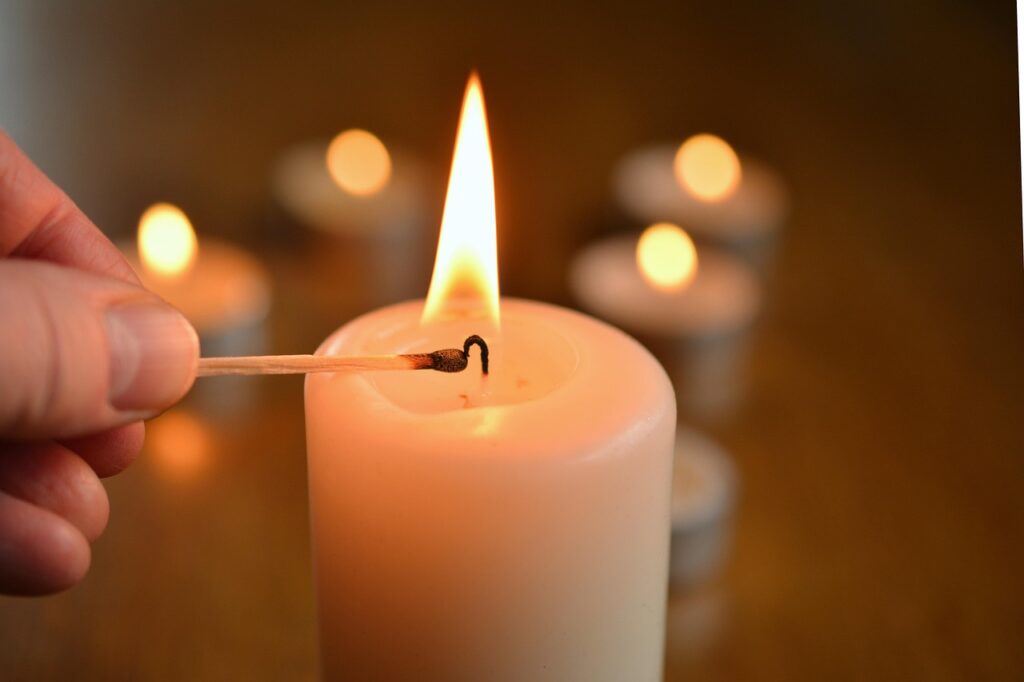
As we enter the first week of Advent, we hear in Matthew’s Gospel, “Therefore, stay awake! For you do not know on which day your Lord will come.” This is a familiar verse and one that we might be tempted to gloss over. Yet, Advent is an invitation to a time of expectation, of quiet waiting, and deep spiritual preparation. It is a time to slow down and consider what it means in our lives in 2025, to stay awake.
Have you ever been so exhausted that you cannot physically stay awake? I am a nervous flyer. I have no problem staying awake on long flights because the adrenaline coursing through my body guarantees that I will not fall asleep. However, my inability to sleep on these flights makes my first day of travel very challenging, excruciating even, and I struggle to stay awake without drinking coffee or espresso. Merely resisting sleep in this exhausted state is not what this passage means by staying awake. Sure, I can keep my eyes open after a long flight, but I am not alert enough to pay attention and perceive what is happening around me.
Today’s Gospel reading is a call not just to have our eyes ajar, but to be alert, attentive, and expectant. That is what it means to stay awake. In this passage, Jesus invites us to recall the Old Testament story of Noah when people were going about their daily lives. They were “eating and drinking, marrying and giving in marriage, up to the day that Noah entered the ark.” Though Moses and his family were building an ark with precise measurements in the midst of their community, onlookers were not sufficiently alert or awake to realize that a great flood was coming. Many people found themselves unprepared when the flood arrived.
In a similar way, we too, can live life in a distracted state. Especially in this modern age, our lives are fast and overstimulated. During the holiday season, we zip from parties, to shopping, to school plays and concerts, fueling ourselves on cookies and coffees. Our bodies are in motion but not necessarily alert or awake to the miracle of Advent: Christ is coming.
The invitation to stay awake beckons us to be conscious of the virtue of hope, of the miracle of life, and the prodigious love that our God has for us in choosing to become incarnate. Let us stay awake this season to be attentive to the details surrounding Jesus’ birth and to prepare ourselves for His ultimate return in glory.
Daily Reading

Thursday of the First Week of Advent
Reading I Isaiah 26:1-6 On that day they will sing this song in the land of Judah: “A strong city have we; he sets up walls and…
Saint of the Day
St. John of Damascus
St. John of Damascus
Feast date: Dec 04
Catholics remember and celebrate the life of the great Arab Church Father St. John of Damascus on Dec. 4.Eastern Orthodox Christians and Eastern Catholics, whose tradition has been particularly shaped by his insights, celebrate the saint’s feast on the same day as the Roman Catholic Church.Among Eastern Christians, St. John (676-749) is best known for his defense of Christian sacred art, particularly in the form of icons. While the churches of Rome and Constantinople were still united during St. John’s life, the Byzantine Emperor Leo III broke radically from the ancient tradition of the church, charging that the veneration of Christian icons was a form of idolatry.John had grown up under Muslim rule in Damascus, as the child of strongly Christian parents. His excellent education – particularly in theology – prepared him well to defend the tradition of sacred iconography, against the heresy of the “iconoclasts,” so-called because they would enter churches and destroy the images therein.During the 720s, the upstart theologian began publicly opposing the emperor’s command against sacred images in a series of writings. The heart of his argument was twofold: first, that Christians did not actually worship images, but rather, through them they worshiped God, and honored the memory of the saints. Second, he asserted that by taking an incarnate physical form, Christ had given warrant to the Church’s depiction of him in images.By 730, the young public official’s persistent defense of Christian artwork had made him a permanent enemy of the emperor, who had a letter forged in John’s name offering to betray the Muslim government of Damascus. The ruling caliph of the city, taken in by the forgery, is said to have cut off John’s hand. The saint’s sole surviving biography states that the Virgin Mary acted to restore it miraculously. John eventually managed to convince the Muslim ruler of his innocence, before making the decision to become a monk and later a priest.Although a number of imperially-convened synods condemned John’s advocacy of Christian iconography, the Roman church always regarded his position as a defense of apostolic tradition. Years after the priest and monk died, the Seventh Ecumenical Council vindicated his orthodoxy, and ensured the permanent place of holy images in both Eastern and Western Christian piety.St. John of Damascus’ other notable achievements include the “Exact Exposition of the Orthodox Faith,” a work in which he systematized the earlier Greek Fathers’ thinking about theological truths in light of philosophy. The work exerted a profound influence on St. Thomas Aquinas and subsequent scholastic theologians. Centuries later, St. John’s sermons on the Virgin Mary’s bodily assumption into heaven were cited in Pope Pius XII’s dogmatic definition on the subject.The saint also contributed as an author and editor, to some of the liturgical hymns and poetry that Eastern Orthodox and Eastern Catholics still use in their celebrations of the liturgy.“Show me the icons that you venerate, that I may be able to understand your faith.” – Saint John of Damascus