
In five days we will be celebrating Christmas and even in these final days of Advent many are already attending Christmas parties and rejoicing with the “joy of the season.” Once again we’re celebrating the birth of Christ, the Light of the World, as we continue to walk through the darkness that has swirled around us for the past couple years.
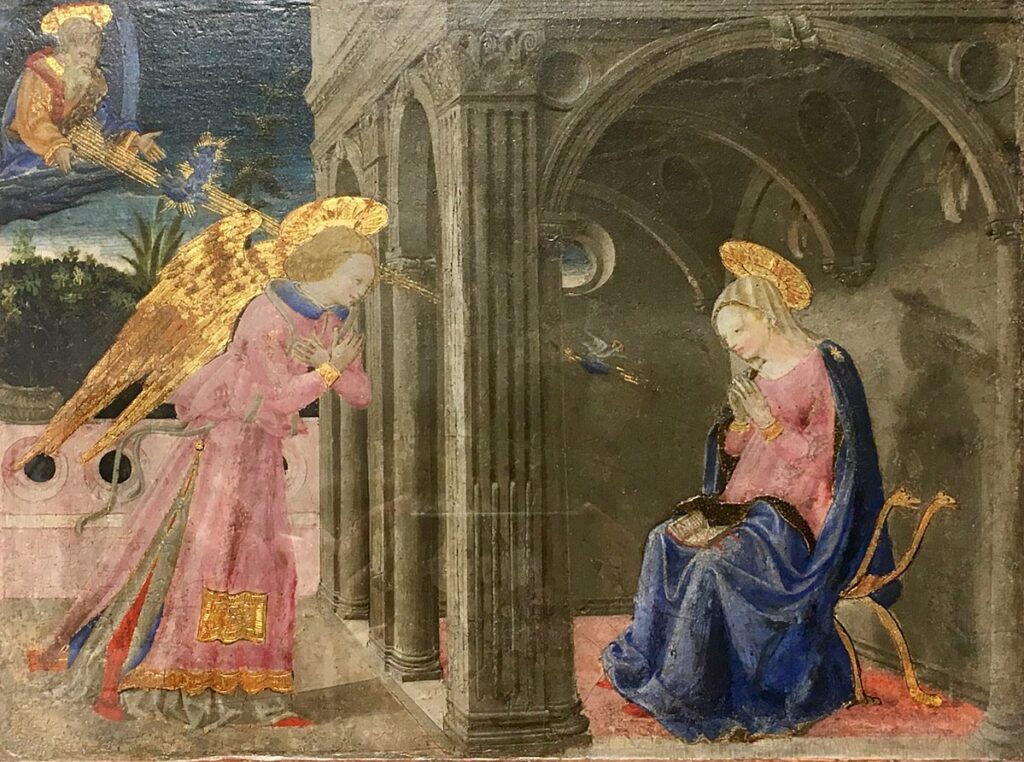
Today’s Gospel introduces the young girl who would mother the Son of God, the woman whose response to the angel Gabriel would bring to birth the eternal Joy that would wipe away our tears.
“Mary said, ‘Behold, I am the handmaid of the Lord. May it be done to me according to your word.’ Then the angel departed from her” (Luke 1:38).
In the midst of the darkness of the world she lived in, Mary believed in the promise of God that she was the Mother of his Son. Mary’s life returned to normal as the angel left her. How could she explain what the Holy Spirit had brought about in her? Who would understand? She didn’t celebrate the first Advent expectation for the birth of the Christ, she lived it in her flesh and in the solitude of faith. She walked through nine months toward the birth of her Son with an open heart, increasingly overwhelmed with wonder, gradually more aware that her walk of faith would be a path of suffering.
Mary was the first to know the “joy of the season.” We learn from the narrative of the Annunciation, that it is in the midst of the daily routine of our own lives that we receive the most beautiful announcement we can hear: “Rejoice, the Lord is with you!” Our Christmas celebrations, though important, are but a flicker of joy compared with the story of God’s relentless love for us, the true cause of our joy.
Pope Francis said that “God continues to look for allies, he continues to seek men and women capable of believing, remembering and recognizing that they are part of his people and cooperating with the Holy Spirit.” He seeks for “hearts capable of listening to his invitation and making it become flesh here and now” (Pope Francis, March 25, 2017).
The young girl Mary shows all of us the only response to this God that will bring the world joy: “May it be done to me as you say. I am saying YES to your whole plan. I give you myself, here, now, and forever. I give myself to your plan for the world through me.” God’s plans are far more beautiful than any plan we could create for ourselves.
In his sermon on December 6, 2019, Father Raniera Cantalamessa wrote: “The contemplation of Mary’s faith urges us to renew, above all, our personal act of faith and abandonment to God. That is why it is so vitally important to say to God, once in life, let it be done, fiat, as Mary did. This is an act enveloped in mystery because it involves grace and freedom at the same time; it is a form of conception. The soul cannot do it alone; God helps, therefore, without taking away freedom.”
In these final days of Advent let the joy that fills your heart, be the amazing realization that the Lord is with you! Whatever may be your sorrows or distress this Christmas season let the Virgin of the Annunciation, the Mother of the Lord, assure you again and again, “Rejoice, my child, the Lord is with you!”
Contact the author
 Kathryn James Hermes, FSP, is the author of the newly released title: Reclaim Regret: How God Heals Life’s Disappointments, by Pauline Books and Media. An author and spiritual mentor, she offers spiritual accompaniment for the contemporary Christian’s journey towards spiritual growth and inner healing. She is the director of My Sisters, where people can find spiritual accompaniment from the Daughters of St. Paul on their journey. Website: www.touchingthesunrise.com Public Facebook Group: https://www.facebook.com/groups/srkathrynhermes/ For monthly spiritual journaling guides, weekly podcasts and over 50 conferences and retreat programs join my Patreon community: https://www.patreon.com/srkathryn.
Feature Image Credit: Wikimedia Commons, https://commons.wikimedia.org/wiki/File:Annunciazione,_Apollonio_di_Giovanni,_Museo_della_Collegiata,_Castiglione_Olona.jpg
Daily Reading

Friday of the Twenty-ninth Week in Ordinary Time
Reading 1 Ephesians 4:1-6 Brothers and sisters:I, a prisoner for the Lord,urge you to live in a manner worthy of the call you have received,with all humility and gentleness, with…
Saint of the Day
Saint John of Capistrano
St. John of Capistrano led a crusade at 70, achieving victory at the Battle of Belgrade in 1456, and is celebrated on October 23. The post Saint John of Capistrano